Friday, December 2, 2011

Fmeale genital mutilation-Towards an end to the Cloak and Dagger ?

The Female Genital Mutilation (FGM) education campaign progressed remarkably smoothly in Laikipia North this year, now in its third year the 28 established NHP Health Workers and their support team , led by NHP Nurse Rose, are now proving to be a self motivated and highly efficient team –Rose’s smile and calmness have maintained a positive effect on the whole community, deflecting the fiery exchanges seen in our first year.


The new Bill outlawing FGM, passed on September 7th, has helped this campaign dramatically. The Bill, proposed by Mt Elgon MP Fred Kapondi back in 2010, provides that a person convicted of carrying out FGM will face seven years in jail or a half million shilling fine; causing death via FGM can result in life imprisonment. Aiding and abetting FGM also carries heavy penalties. Three years ago it was difficult to get local politicians to support the campaign to, at the least, delay female circumcision, since they were not sure on which side votes lay; but the new law has made things clear for all. We have been fortunate that the local Chiefs have taken a very positive and forward thinking stand, ensuring that progress over the last three years has been fast. Traditionally, as soon as a girl has been circumcised she is pronounced ‘ready’ for marriage, leading to the end of her education. But in many cases the Chiefs have actively insisted that girls not be taken out of Primary school and have also assisted them in registering themselves in school, where local teachers have identified girls being kept at home.

Our campaign in Isiolo is in its first year, with a brand new team of highly enthusiastic Health Workers. Here many lessons have to be learned concerning logistics- particularly as we are currently drowning under a sea of mud, wiping out roads on a daily basis.And never underestimate the infinite time required for Kenyan politics ! No one can focus on education until the all important decisions of how many ‘lunch’ goats to be assigned to each village has been settled. Perhaps such precise allocation decisions have more priority in the Samburu community than in the Masai community where NHP was formerly based. We still have the biggest Baraza (meeting) tomorrow, and rains permitting, we will meet our last year total of over 2,000 attendees.

The team are promoting an alternative public ‘Blessing’ for the girls as their Coming of Age ceremony- rather than the Cloak and Dagger (..literally) ceremony that has been taking place behind closed doors for so many years. Since the average age for circumcision is puberty this has meant few girls accessing secondary education.

The health problems begin with the infections and heavy bleeding caused by the non-sterile and unprofessional operation, proceed via the hazards of early pregnancies, for girls who often have several more years of growing and are already poorly nourished ; through to large areas of scar tissue causing horrific and often life threatening tears and haemorrhaging during birth. In addition mothers will starve themselves during pregnancy, even when food is plentiful, in order to limit the size of their baby to limit the danger and pain of a healthy birth weight baby.

I cannot say that I am taken in by the argument given against the cut by many men and women, at every baraza that the lack of sexual satisfaction obtained by the women causes more female 'promiscuity' or as generally translated from the Maasai 'prostitution', but I guess I am not one to be able judge this question.

Whilst meetings can be highly charged, and to some it is still seen as a controversial and emotive topic; if each year another cohort of young girls is given the choice to delay the cut until after secondary schooling that has got be a good thing for Kenyan development.. and Kenyan politics.

Saturday, November 26, 2011

Girl's Education.. Family Planning Choices.. and Fertility Rates...

On Tuesday,leaders from around the world meet in Senegal for the International Conference on Family Planning. As the population in Kenya has soared in the past 30 years by two and a half times, with an average growth of 3 percent per annum, this topic needs to be top of kenya’s development agenda.

The current Kenyan population level is 41 million, up from 21 million in 1989. There is no greater challenge to development, as over-population tends to nullify economic progress. With the advent of Free Primary Schooling in 2003, kenya did a great job of getting Bottoms On Seats. Access to education has improved enormously, but as population levels rise the GOK and donor governments have been unable to meet the required funding, particularly in the poorest rural areas where fertility rates remain highest. In schools we work with, if we removed our teaching support, class sizes would rise in some cases to 120 pupils to one teacher. Education for sure: but based on Quantity not Quality.

There is a clear correlation between levels of female education and female fertility rates. Education leads to delay of marriage, to increased knowledge about contraceptive choices, to greater economic choices for women, to increased autonomy in women’s decision making and to greater communication within marriage: all of these assisting in access to Family Planning and increased exercise of choice. As effective FP choices increase so greater education is required. With the advent of three year Implants, choices increase in both number and complexity.

It is inevitably the economic cost of education, versus its perceived benefits that will be the prime determinants of parents sending kids to school in the poorer rural areas. When the drought of 2009 in the Ol Lentille Community killed over three quarters of domestic livestock, not only did the schools see a large increase in enrollment of younger children, but also many Morans, who would formally have been out herding, entered primary school for the first time.

Seven or more years in school cuts fertility rates in half; but it is years in Secondary Education which has the greatest reduction in fertility rate for girls and the greatest delay in marriage. Educating mothers decreases child mortality and leads to healthier infants.Access to Family Planning is a basic Human Right which cannot be seen in isolation from those other basic Human Right- Female Education and the Right to Health Care.

Pictured are the Nabakisho Health Care nurses in action at a mobile clinic at Rumate where FP choices are discussed... levels of understanding of their full range of FP choices will remain hazy for many of these women who have no education.

Thursday, November 24, 2011

Happy Thanksgiving..... much to be grateful for...

Happy Thanksgiving to all our American Friends ......and a reminder to ourselves that we have so much to be grateful for this year. After all these years when our friends in America have probably become fed up with us moaning about endless droughts and the ensuing hardships in the community (...remember 2009 when 80% of cattle died..) In 2011 we have to remind ourselves daily to be grateful for wonderful rainfall.. since March we have not had to worry about empty dams and water tanks and November is proving to be the best rain season that the community can remember for many years.

The conservancy looks stunning with waving grass more redolent of the Masai Mara than of these semi arid lands. Whilst it is somewhat more challenging hunting for the game in these conditions it is certainly there..and at least elephants are always easy to spot... yesterday we stopped counting at 300 and this Greater Kudu was spotted in the morning 'drive' to work ....


It was also the first time in six years that I have spent most of the morning being stuck in the mud... but am certainly not complaining as the sun was out and it is amazing how many friends you make along the way when you are trying to dig yourself out!

So if next year drought bites again, we will look back to this blog and remember that we are not always crying drought....

Sunday, November 20, 2011

Clean Cookstoves... Save Trees.. Save Lives

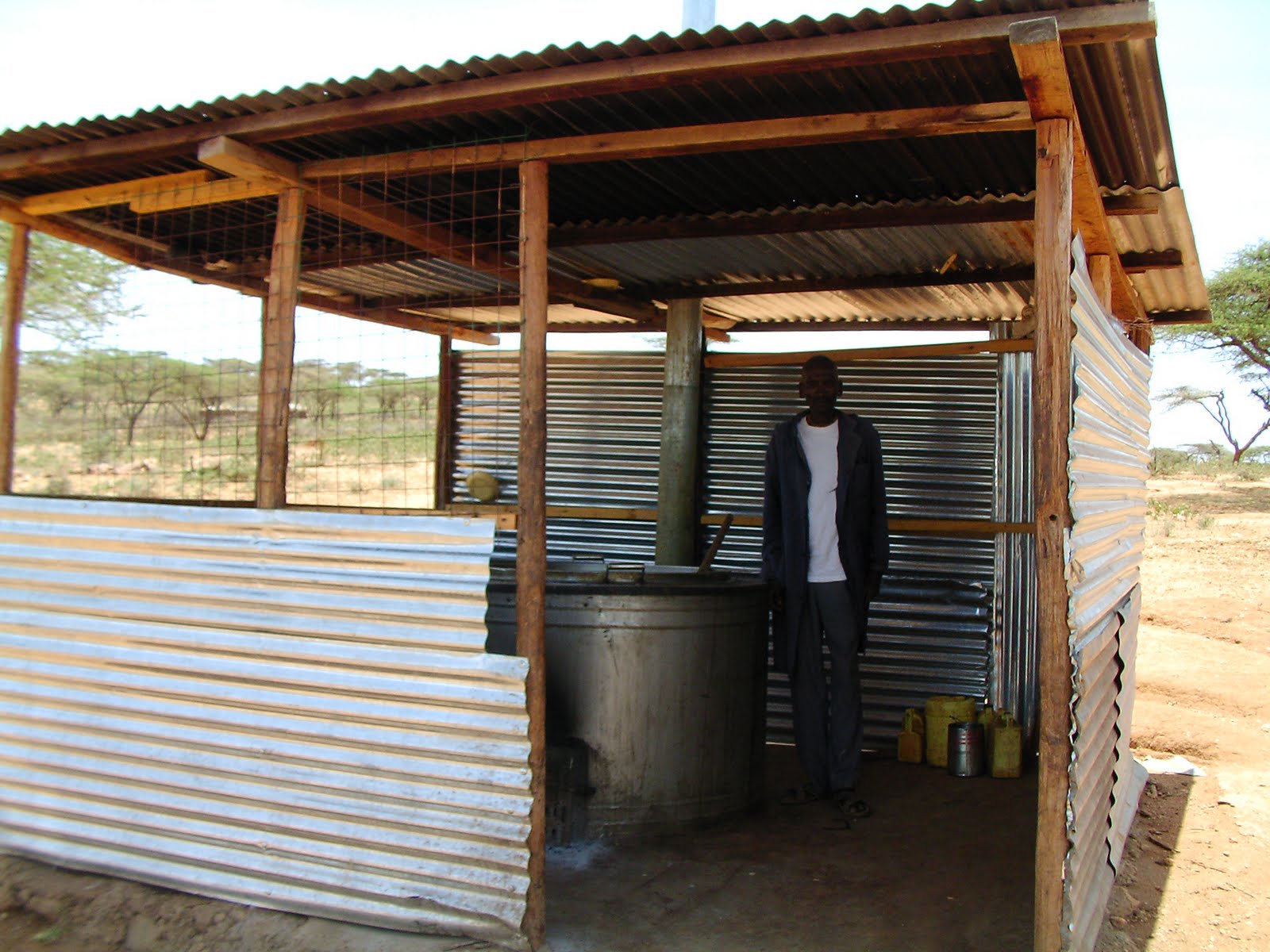
As a follow up to the May 17th blog, this blog is certainly somewhat overdue! With the huge support of Paradigm Stoves , we now have Institutional Stoves working in 9 schools, plus our own Staff Kitchen. This donation has been a resounding success, and no unintended consequences have so far been thrown up. The implementation of the project was bigger than either we, or Paradigm, could have imagined. In the first instance the smaller nursery schools had no kitchens... so step one was to erect simple secure, weather proof, structures.. only not so simple when we realised that we would have to make new roads to Rumate and Singa'un nurseries, before we had any hope of getting materials and stoves to them! Finding a route through the luggas, rocks and dense bush to Singa'un required a day on foot feeling rather Dr. Livingstone'ish, before we could hope to get a pick up through. The huge added advantage of this is that now we have a road that the mobile clinic can traverse once a month to this remote Samburu village. How people survive in this location in the dry season beggars belief.. the trip for water is a 6 hour round trip with donkeys that each household has to perform every two days.
Below is the new kitchen at Narasha Nursery school-


These stoves use a very minimal amount of wood... where children were collecting wood on a daily basis this is now reduced to once or twice per month. Paradigm also provided a training for all the school cooks who have been universally thrilled with the stoves.. where we could have foreseen some resistance to 'new' technology the benefits are all self evident.. virtually no smoke , much quicker cooking times and , an unforeseen benefit of much easier cleaning has led not only to happy cooks but also to a real pride in the cleanliness of the kitchens.


In addition we have given away 80 household stoves to the Ol Lentille employees, Conservancy Rangers and and Health Workers, and have sold another 100 at subsidised prices. We still have some 40 more to sell. This area of the donation has been enormously interesting- (if at times somewhat challenging!) showing how much research we still need to do to work with communities on the best fit of stove for them. Communities being made up of individuals, of course means that no one solution fits all: age , gender, education levels, family size, are just some of the variables we need to consider. This is still very much a work in progress that we will come back to as we collate our results...

Saturday, November 19, 2011

Amazing Maasai Ultra Marathon ....2012

Entries opened today for the 2012 check it out and come and support Girls Education in Laikipia! Runners, volunteers and sponsors all needed!

The inspiration and support for the 2010 Kimanjo Community Marathon.. with the whole community running in support of the new Kimanjo Secondary school.. introduced Molly Fitzpatrick to the Group Ranch Community as the only ‘International’ runner.. (...we were expecting a Chinese girl... but found Molly to be most definitely American... at the time resident in China..) also Molly was the only ‘woman’ to complete the 42K!....as a result of this Molly bravely set up the Amazing Maasai Ultra Marathon 2011... in aid of girls secondary school sponsorships. 15 girls from community Primary schools will receive four years of secondary Boarding full bursaries from this achievement!
Race Director Solomon is pictured below with fellow Ol-Lentille work colleague and marathon running partner, Johnson.

As the first Kenyan Ultra Marathon the 2012 race should really fill a gap in the market and it will be great to introduce more of the Maasai community to these longer distances.. see last year’s winner below... Il Motiok school boy David Simpiri, many miles ahead of the rest of the field... he finished 75K without breaking a sweat...


Musul Group Ranch member Sapuk Safiri is here celebrating his 42K win.. Sapuk is a very useful Kenyan marathon runner and a popular local winner.

Thursday, November 17, 2011

Poaching, rhino horn, education ..... and China links

Everyone enormously pleased to have John back in Kenya following his trip to China. China is not only an enormously important market for tourism in Africa, but it is also a cornerstone in the education fight to combat poaching of rhino horn and elephant ivory. As powdered rhino horn now equals the price of cocaine, surpassing that of gold, the market has become so lucrative that 2011 has seen a major increase in animals lost to poaching, destined for markets primarily in Vietnam and China. In an effort to raise Chinese awareness on this challenge Laikipia Wildlife Forum has hosted many senior Chinese entrepreneurs and government officials this year to show them the important rhino conservation work being done in Laikipia in conservancies such as Ol Pejeta and Ol Jogi. In the last month three elephants have been poached in areas relatively close to the Ol Lentille conservancy. John welcomed the chance to talk to many prominent Chinese business people, and we look forward next year to being able to show some of them these animals in their natural habitat. It is great to see this growing understanding that we must all be working together to extend these educative links: if the rhino is to survive much longer the power of the camera lens and the healthy safari experience has to be harnessed.... above that of the bullet and the supposed 'curative' effect of powdered horn.

Wednesday, November 16, 2011

Water.. Water ... Water...and Water Holes...

After six years of struggling with a cycle of droughts we are now swimmingly enjoying one of the wettest rainy seasons the Kijabe Group Ranch has ever seen... as rains sweep across kenya. The conservancy has never looked better. In our strategy to build more dams, to keep elephants out of the community dams and mitigate the conflicts they cause there, last month we embarked on a major new dam project.
As the workforce is now underway constructing the seven metre (yes METRE!!) wall for this latest dam, their biggest challenge is not to drown in the ever deepening lake! Enormous thanks to recent volunteer Audrey and her Great Friends for their fund-raising for this project... and to Derek for his fund raising AND very useful technical support. the rain is also working to our advantage in having dispersed our resident 80 elephants further north .. allowing the workforce to get on uninterrupted .....