Showing posts with label development. Show all posts
Showing posts with label development. Show all posts
Thursday, February 16, 2012
Neglected Tropical Diseases on Aljazeera
Following on from our blog on NTDs last week, this is the broadcast from the Al Jazeera news channel publicising and explaining the partnership between Pharmaceutical companies, governments and the public. What are your thoughts, readers? Positive or negative?


Wednesday, February 15, 2012
How to give sanitation sex appeal??
It’s hardly surprising that the building of pit latrines in the poorest countries is one of the least funded and most overlooked areas of health development. A vast amount more sex appeal will be found in other highly worthy public healthcare needs- malaria bed nights, for instance, undoubtedly save thousands of babies lives and are easy to distribute... in addition to lending themselves to great marketing opportunities to photo peaceful sleeping babies. Yet 2.6 billion people do not have access to a safe latrine and this includes half of people in sub Saharan Africa.

4,000 children die daily from preventable water related diseases- more than die from malaria, HIV and measles combined. Diarrhoea is the second biggest killer of children under 5.
Improved sanitation could prevent 1.5 million deaths from diarrhoeal diseases per year. The environmental rewards would also be enormous as currently 200 million tonnes of human waste go uncollected and untreated each year. It is estimated that every dollar spent on sanitation would save nine dollars in days lost from work plus the cost to the local health services. As much as 5% of African GDP is lost to illness and deaths caused by dirty water and lack of basic sanitation.
One of the Millenium development Goals is to halve the proportion of people without access to basic sanitation by 2015. Currently sub Saharan Africa will be at least fifty years late with this MDG unless the health agenda rapidly decided to focus money and effort here.
The added improvement to quality of life is probably larger than any other public health intervention. Whilst a good immunisation campaign will save millions of lives...it does nothing to improve the daily life of its recipients. Yet it doesn’t take much imagination to see that if you offer an adolescent girl an opportunity to use a safe, private latrine you have improved her life beyond measure. Certainly give girls access to education and books... but how many campaigns focus on giving her access to a childhood and adolescence where she can enjoy the basic human right to personal privacy.
Of all the public health interventions we have undertaken this is the most universally popular one with the community. Whilst it is very hard to evaluate whether families using pit latrines are accessing health care less, it is at least easy to assess how much they are used : in every case the take up in use of the latrine amongst school age children and adults is virtually universal: if a latrine is there it is used by all but the youngest children and a few of the very old and infirm. In addition we have not yet come across a manyatta across the group ranches who have turned down the opportunity to have a latrine.
But it is an expensive intervention. After we complete this year’s agreed building programme we will be working with the micro finance project to see if they can help us with low interest development loans for pit latrines and looking to ways of cost sharing with families. But still it will remain expensive ..... and of course it is the poorest families who probably need the latrines most as their family numbers are generally higher and their health education is generally lowest. It is good to see some NGOs also focusing on latrines in Isiolo district- but here the problems remain the same; most NGOs will fund only basic materials, building and adding materials has to be added by families and consequently they are out of the reach of the poorer families. In addition, not unnaturally it is the village ‘centres’ and schools which are generally targeted , where the need is highest, but again the poorest of the poor will miss out.
Thursday, February 9, 2012
And Public Private Partnerships in Water Development - (Swimming Pools and Power Showers??)
We have now sunk and capped the new community bore hole in Kimanjo. Finding water was a great day. Still waiting for the hydrology report which will tell us the recharge rate along with the water quality.

Despite the usual Kenyan hiccups in the process: transport dilemmas and break downs for the drilling rig as the November rains had washed out roads; a broken rod down the borehole which meant many days of arduous work for the guys operating the machine etc. etc ; this has been a project enormously assisted at every stage by the District Water Officer who has unfailingly given practical assistance to mitigate hold ups and given sound professional advice throughout. His ability to overcome obstacles in the cause of getting water to a remote area shows how successful the much vilified government agencies (how often are those two terms African government agency and corruption used synonymously?) can be when they have committed, honest, active and knowledgeable personnel on the ground. A good news story from an African government agency? Without doubt.
In the next phase of development we very much look forward to continuing this partnership with the District Water Office to equip the bore hole with a solar pump, put in two pipe lines- to the Primary and new secondary school, and a second to the upcoming Health Centre with a new holding tank at the top of the village. In addition the extreme cooperation and assistance of the Kimanjo Water Users Association, and their highly active Chairman, have meant that achieving the necessary licenses and permits and the cooperation of the community has been made easy. Whilst in future wars will undoubtedly be fought over water (and the lack of it) in Africa, it must also be remembered that water is capable of uniting communities for the common good.Two good news Africa stories here then. On all those occasions when we are feeling cynical in the field of African development how important it is to remember the good days and so, so many good people .
Does this mean everyone in Kimanjo will now be able to use water ad lib? Far from it. Even should the recharge rate be better than anticipated , families are unlikely to be collecting much more than 20- 40 litres of water a day. That is whole families. Compare this to the US average of 700 litres per day per person.... with 153 litres per person merely for washing and drinking. The rural African average water consumption is around 30-40 litres a day, but far less in these semi arid and arid lands. One eight litre flush of the toilet in Europe will use more water than adults here would use in a day... with considerably less used during drought periods.
So.... no swimming pools or power showers just yet.... but, if our partnership with the Water Office continues as successfully as it has been for the past few months it should not be too long before life is a good deal easier for many women and children.. with the added advantage that our Health Centre build can now ramp up momentum. And this will be down to a great Community effort.
Friday, December 2, 2011
Fmeale genital mutilation-Towards an end to the Cloak and Dagger ?
The Female Genital Mutilation (FGM) education campaign progressed remarkably smoothly in Laikipia North this year, now in its third year the 28 established NHP Health Workers and their support team , led by NHP Nurse Rose, are now proving to be a self motivated and highly efficient team –Rose’s smile and calmness have maintained a positive effect on the whole community, deflecting the fiery exchanges seen in our first year.

The new Bill outlawing FGM, passed on September 7th, has helped this campaign dramatically. The Bill, proposed by Mt Elgon MP Fred Kapondi back in 2010, provides that a person convicted of carrying out FGM will face seven years in jail or a half million shilling fine; causing death via FGM can result in life imprisonment. Aiding and abetting FGM also carries heavy penalties. Three years ago it was difficult to get local politicians to support the campaign to, at the least, delay female circumcision, since they were not sure on which side votes lay; but the new law has made things clear for all. We have been fortunate that the local Chiefs have taken a very positive and forward thinking stand, ensuring that progress over the last three years has been fast. Traditionally, as soon as a girl has been circumcised she is pronounced ‘ready’ for marriage, leading to the end of her education. But in many cases the Chiefs have actively insisted that girls not be taken out of Primary school and have also assisted them in registering themselves in school, where local teachers have identified girls being kept at home.
Our campaign in Isiolo is in its first year, with a brand new team of highly enthusiastic Health Workers. Here many lessons have to be learned concerning logistics- particularly as we are currently drowning under a sea of mud, wiping out roads on a daily basis.And never underestimate the infinite time required for Kenyan politics ! No one can focus on education until the all important decisions of how many ‘lunch’ goats to be assigned to each village has been settled. Perhaps such precise allocation decisions have more priority in the Samburu community than in the Masai community where NHP was formerly based. We still have the biggest Baraza (meeting) tomorrow, and rains permitting, we will meet our last year total of over 2,000 attendees.
The team are promoting an alternative public ‘Blessing’ for the girls as their Coming of Age ceremony- rather than the Cloak and Dagger (..literally) ceremony that has been taking place behind closed doors for so many years. Since the average age for circumcision is puberty this has meant few girls accessing secondary education.
The health problems begin with the infections and heavy bleeding caused by the non-sterile and unprofessional operation, proceed via the hazards of early pregnancies, for girls who often have several more years of growing and are already poorly nourished ; through to large areas of scar tissue causing horrific and often life threatening tears and haemorrhaging during birth. In addition mothers will starve themselves during pregnancy, even when food is plentiful, in order to limit the size of their baby to limit the danger and pain of a healthy birth weight baby.
I cannot say that I am taken in by the argument given against the cut by many men and women, at every baraza that the lack of sexual satisfaction obtained by the women causes more female 'promiscuity' or as generally translated from the Maasai 'prostitution', but I guess I am not one to be able judge this question.
Whilst meetings can be highly charged, and to some it is still seen as a controversial and emotive topic; if each year another cohort of young girls is given the choice to delay the cut until after secondary schooling that has got be a good thing for Kenyan development.. and Kenyan politics.

The new Bill outlawing FGM, passed on September 7th, has helped this campaign dramatically. The Bill, proposed by Mt Elgon MP Fred Kapondi back in 2010, provides that a person convicted of carrying out FGM will face seven years in jail or a half million shilling fine; causing death via FGM can result in life imprisonment. Aiding and abetting FGM also carries heavy penalties. Three years ago it was difficult to get local politicians to support the campaign to, at the least, delay female circumcision, since they were not sure on which side votes lay; but the new law has made things clear for all. We have been fortunate that the local Chiefs have taken a very positive and forward thinking stand, ensuring that progress over the last three years has been fast. Traditionally, as soon as a girl has been circumcised she is pronounced ‘ready’ for marriage, leading to the end of her education. But in many cases the Chiefs have actively insisted that girls not be taken out of Primary school and have also assisted them in registering themselves in school, where local teachers have identified girls being kept at home.
Our campaign in Isiolo is in its first year, with a brand new team of highly enthusiastic Health Workers. Here many lessons have to be learned concerning logistics- particularly as we are currently drowning under a sea of mud, wiping out roads on a daily basis.And never underestimate the infinite time required for Kenyan politics ! No one can focus on education until the all important decisions of how many ‘lunch’ goats to be assigned to each village has been settled. Perhaps such precise allocation decisions have more priority in the Samburu community than in the Masai community where NHP was formerly based. We still have the biggest Baraza (meeting) tomorrow, and rains permitting, we will meet our last year total of over 2,000 attendees.
The team are promoting an alternative public ‘Blessing’ for the girls as their Coming of Age ceremony- rather than the Cloak and Dagger (..literally) ceremony that has been taking place behind closed doors for so many years. Since the average age for circumcision is puberty this has meant few girls accessing secondary education.
The health problems begin with the infections and heavy bleeding caused by the non-sterile and unprofessional operation, proceed via the hazards of early pregnancies, for girls who often have several more years of growing and are already poorly nourished ; through to large areas of scar tissue causing horrific and often life threatening tears and haemorrhaging during birth. In addition mothers will starve themselves during pregnancy, even when food is plentiful, in order to limit the size of their baby to limit the danger and pain of a healthy birth weight baby.
I cannot say that I am taken in by the argument given against the cut by many men and women, at every baraza that the lack of sexual satisfaction obtained by the women causes more female 'promiscuity' or as generally translated from the Maasai 'prostitution', but I guess I am not one to be able judge this question.
Whilst meetings can be highly charged, and to some it is still seen as a controversial and emotive topic; if each year another cohort of young girls is given the choice to delay the cut until after secondary schooling that has got be a good thing for Kenyan development.. and Kenyan politics.
Saturday, November 26, 2011
Girl's Education.. Family Planning Choices.. and Fertility Rates...
On Tuesday,leaders from around the world meet in Senegal for the International Conference on Family Planning. As the population in Kenya has soared in the past 30 years by two and a half times, with an average growth of 3 percent per annum, this topic needs to be top of kenya’s development agenda.
The current Kenyan population level is 41 million, up from 21 million in 1989. There is no greater challenge to development, as over-population tends to nullify economic progress. With the advent of Free Primary Schooling in 2003, kenya did a great job of getting Bottoms On Seats. Access to education has improved enormously, but as population levels rise the GOK and donor governments have been unable to meet the required funding, particularly in the poorest rural areas where fertility rates remain highest. In schools we work with, if we removed our teaching support, class sizes would rise in some cases to 120 pupils to one teacher. Education for sure: but based on Quantity not Quality.
There is a clear correlation between levels of female education and female fertility rates. Education leads to delay of marriage, to increased knowledge about contraceptive choices, to greater economic choices for women, to increased autonomy in women’s decision making and to greater communication within marriage: all of these assisting in access to Family Planning and increased exercise of choice. As effective FP choices increase so greater education is required. With the advent of three year Implants, choices increase in both number and complexity.
It is inevitably the economic cost of education, versus its perceived benefits that will be the prime determinants of parents sending kids to school in the poorer rural areas. When the drought of 2009 in the Ol Lentille Community killed over three quarters of domestic livestock, not only did the schools see a large increase in enrollment of younger children, but also many Morans, who would formally have been out herding, entered primary school for the first time.
Seven or more years in school cuts fertility rates in half; but it is years in Secondary Education which has the greatest reduction in fertility rate for girls and the greatest delay in marriage. Educating mothers decreases child mortality and leads to healthier infants.Access to Family Planning is a basic Human Right which cannot be seen in isolation from those other basic Human Right- Female Education and the Right to Health Care.
Pictured are the Nabakisho Health Care nurses in action at a mobile clinic at Rumate where FP choices are discussed... levels of understanding of their full range of FP choices will remain hazy for many of these women who have no education.

The current Kenyan population level is 41 million, up from 21 million in 1989. There is no greater challenge to development, as over-population tends to nullify economic progress. With the advent of Free Primary Schooling in 2003, kenya did a great job of getting Bottoms On Seats. Access to education has improved enormously, but as population levels rise the GOK and donor governments have been unable to meet the required funding, particularly in the poorest rural areas where fertility rates remain highest. In schools we work with, if we removed our teaching support, class sizes would rise in some cases to 120 pupils to one teacher. Education for sure: but based on Quantity not Quality.
There is a clear correlation between levels of female education and female fertility rates. Education leads to delay of marriage, to increased knowledge about contraceptive choices, to greater economic choices for women, to increased autonomy in women’s decision making and to greater communication within marriage: all of these assisting in access to Family Planning and increased exercise of choice. As effective FP choices increase so greater education is required. With the advent of three year Implants, choices increase in both number and complexity.
It is inevitably the economic cost of education, versus its perceived benefits that will be the prime determinants of parents sending kids to school in the poorer rural areas. When the drought of 2009 in the Ol Lentille Community killed over three quarters of domestic livestock, not only did the schools see a large increase in enrollment of younger children, but also many Morans, who would formally have been out herding, entered primary school for the first time.
Seven or more years in school cuts fertility rates in half; but it is years in Secondary Education which has the greatest reduction in fertility rate for girls and the greatest delay in marriage. Educating mothers decreases child mortality and leads to healthier infants.Access to Family Planning is a basic Human Right which cannot be seen in isolation from those other basic Human Right- Female Education and the Right to Health Care.
Pictured are the Nabakisho Health Care nurses in action at a mobile clinic at Rumate where FP choices are discussed... levels of understanding of their full range of FP choices will remain hazy for many of these women who have no education.

Sunday, June 5, 2011
Ol Lentille Conservancy part 5: the future is global
We now have a community with diversified livelihoods, less dependent on livestock, which are so vulnerable to the massive problem of climate change. The land is improving, lessening the impact of climate change, the potential for abundant grazing is around the corner; and there is the prospect of carbon income.
So how does the community perceive these changes? In the (in)famous words of Bill Clinton (no not those words ;)):

This community has so far sacrificed 20,000 acres of their land for conservation. They could have used the grazing, or they could have rented it out. They could have put 2000 cattle onto that land for 6 months of the year. And they could have had an income from it of $30,000 per year. Instead, total economic input from all sources generated by the Project has averaged $400,000 a year for the past 5 years.
In itself this is a community development challenge: a large and sudden increase in income and wealth is something most people do not deal with very well. Look at lottery winners- no different here! The temptation for a corrupt elite to pocket the dosh is huge. So here, much (though not all) of the income goes into infrastructure projects like new and improved schools, additional clinic nurses, a mobile clinic. Decisions on what projects to undertake are taken jointly by community members (teachers, elders, ranch officials, ranch members etc) and Regenesis directors and staff.
 |
| Nkiloriti Nursery School in 2006 |
 |
| Inside new classroom number 2 at Nkiloriti, 2010 |
Under the agreement with Regenesis the approximately $50,000 a year which is free cash, deposited into the ranch bank account, has to be used “transparently and equitably for the benefit of the entire community”, and is audited. AWF has supported the setting up of a village microfinance bank, and community leaders including women (traditionally marginalized in this society) are getting financial and business training and advice.
 |
| Women of Lentille community, with visiting teacher from UK |
This blog was supposed to be about our conservation strategy. For those disappointed that there are not lots of wildlife stories, I apologise. But conservation is not about wildlife. It is about people. (Though we do still get extremely excited when we spot the endangered African Wild Dog hunting in front of the lodge, and happily watch elephants ‘playing’ at destroying things for hours)
 |
| African Wild Dog in Sinyai lagha, Ol Lentille Conservancy |
The biggest question of all though, is can conservation pay? The answer is yes. However, if the world wants to conserve the wildlife and ways of life of East Africa , it is the world which will have to pay. Rural East Africans can successfully be in the business of selling to a world market so-called “ecosystem services”, but the international community and its Earth Summits and the plethora of well-meaning but for 50 years wholly ineffective NGOs will have to wake up.

The Tanzanian government (the same one that wants to drive a highway through the Serengeti National Park ), wants to put a soda factory on Lake Natron Lake Natron Tanzania
Monday, May 30, 2011
The Politics of Poverty
Development professionals have recently started talking more about the role of politics in opportunities or constraints for poverty reduction, alongside the role of economic growth. This shows recognition of the role of governance in development and the need for appreciating politics when considering development opportunities. Even the notoriously economic-centric World Bank has begun to reassess its apolitical stance, through consideration of the role of corruption in development.
I write this because, in Kenya, every development goal we seek is hindered, affected, constrained or, occasionally, helped by politics and corruption. Policymaking is highly politicised, resource allocation is often unequal on the grounds of ethnicity (which is also a primarily political issue) and the inequality in the country, at an all-time high, has been made worse by corruption in all levels of politics, the judiciary, the police service and service delivery. It is an issue we deal with every day working in Kenya, and one I am particularly passionate about tackling.
Politics is in everything: governance, policy, institutions and the ‘bigger picture’ of political ideologies and systems- there is huge scope for poverty reduction strategies to be politicised. Politics and poverty will always be country specific, affected by history, political parties, ideology, civil society and the types of institution in that nation, as well as international interactions with regard to aid, trade and conflict, which all impact upon poverty and its alleviation.
The idea of pro-poor politics as opposed to pro-poor economics emerged out of the good governance debate. Good governance alone is insufficient for development- governance reforms will only benefit the poor if they have representation and influence over institutions. A pro-poor polity must have the capability and commitment to creating an environment that allows space for citizen participation to reduce poverty through empowerment and through accountability and responsiveness of the government for improved resource allocation and service delivery.
Kenyan citizens have huge political motivation. In my time living in England, I have been saddened by the lack of interest in the country’s political situation, and the lack of knowledge of politics even at the basic level (try asking a bunch of 15 year olds who the PM is). In Kenya, people have passion, commitment and interest in politics and reform. John Githongo (the former anti-corruption tzar, exiled for whistleblowing and now back in Kenya) has started a social movement called ‘Ni Sisi’ – "It is us". We, the people of Kenya, must work to hold our government to account, to not accept corrupt practice and to use the political landscape to our advantage, encouraging the implementation of pro-poor policies alongside supporting the country’s economic growth. Transparency in politics is also necessary, to provide the appropriate information to citizens to allow them to better influence policy debates and political discourse.
We need political leaders committed to poverty reduction through service delivery, economic stability, social and state security, well-devised policies, both social and infrastructural, with capacity to implement them equitably, and a state responsive to civil society. We need a state which allocates resources equitably and efficiently. We need a government that exhibits capability, responsiveness and accountability to all citizens. Only then can Kenya attract more investment potentially improving the environment for poverty reduction, and ensure equitable resource allocation.
The aim of pro-poor politics is to create a political system that allows space for citizen participation, leading to poverty reduction through empowerment and enhanced policy focus and implementation, via advocacy and improving accountability of those in power to all citizens. This process is limited by political structures and affected by the agenda set by the powerful elite.
Though a state may be considered broadly democratic, there are varying levels of democracy. Corruption, excessive Presidentialism and patronage politics may perpetuate poverty. This occurs more often in a fragmented political system where many political parties, with little regulation or commitment to the poor, compete to ‘rule rather than to serve’ the citizens.
Though it is political leaders that have official power in many polities, the civil service can affect implementation of policy and therefore poverty levels. If employment in civil service is highly politicised (and oversized), it diverts resources away from poverty reduction strategies and thus reproducing poverty in the country. Weak institutions, lacking capacity and commitment, mean the mixture of ‘formal and informal rules’ will affect policy formulation and implementation, determining whether outcomes are pro-poor or not. Strong institutions are able to ‘rein in the power of individuals’ and produce the rule of law, via downward accountability. This will have positive effects in terms of poverty reduction, ensuring appropriate and equitable resource allocation. If institutions are weak, or informal rules dominate, the use of power cannot be regulated, leading to non-delivery of pro-poor policies, or formulation of policies which exacerbate poverty. Those who are unable to affect these informal rules therefore suffer disproportionately.
As a group, people can gain power and influence decisions that affect their lives, advocating for appropriate resource allocation and protest against ‘anti-poor’ political structures and informal rules. Influence can be used to ensure that the government use their power appropriately and effectively to improve the lives of the citizens.
But what if an environment for social mobilisation cannot be created? If political power has been gained through support from a regional group, ethnic loyalty or economic wealth, the poor feel powerless to effect change. If elites are governing in their own interests, the poor, who feel vulnerable, are unwilling and unable to challenge the state. Personal or patronage rule inhibits social organisation.
Poor governance structures affect the political capabilities of the poor, directly affect service delivery, through misallocation of resources and funds and hinder external investment and donor collaboration. Important aspects of poverty reduction are empowerment and service delivery, as well as security, from economic shocks, corruption and criminal activity. These will all be compromised by corrupt practices and informalised political structures. We need transparency and accountability measures to improve the situation, as well as decentralisation of power, thus providing citizens with knowledge about the resource allocation process. The new constitution may well help this in Kenya.
Politics is about power relations. It is the distribution of power that affects a state’s ability to implement successful poverty reduction strategies. This includes issues of corruption and conflict and can be somewhat counteracted by effective, appropriate institutions staffed according to merit rather than patronage, allowing for some regulation of power and therefore resource distribution, improving service delivery to the poorest. There must first be sufficient political commitment and capability to pro-poor politics to enable bottom-up advocacy for change. Poverty can be defined in terms of empowerment, service delivery, access to markets and security. The political system and informal rules can shape these aspects of poverty. The most crucial ingredient to political development is organisation and mobilisation of the poor, as it is they who can potentially influence those with the power to effect pro-poor change.
Friday, May 20, 2011
Ol Lentille Conservancy part 3: Conservation for development
Seeing the very visible and dramatic changes in the health of this land, and also the tourism and community development benefits (such as education and healthcare programmes) the area was receiving, neighbouring communities asked to participate in the conservation programme. So the Ol Lentille Conservancy is now 20,000 acres belonging to 4 communities. This year we are set to go to close to 30,000 acres as a fifth community comes on board.

Now we know we can save degraded land and bring it back into good health, we have started scientific monitoring of plants and soil quality. We work with Kenyan environmental consultants Wajibu MS to do this. We have trained local monitoring staff and had Speedbird satellite imagery done to enable this. The International Livestock Research Institute whose global headquarters is in Nairobi
 |
| Ngabolo School children on a day out in the Ol Lentille Conservancy |
The 'carbon credits' phenomenon has been accused of a. not working to combat climate change and b. encouraging exploitation of developing countries. This may well be true at some levels. Of course the trading has to be done right, like all development programmes- the 'how' matters. Wangari Maathai, Nobel Peace Laureate, has endorsed the involvement of tree-farming in her Green Belt Movement in the Carbon market, knowing that if done right, carbon trading has true potential. Conservation here is about people, and finding a way to allow communities to sustain their way of life by improving their environment. Carbon trading can do that for this community. It provides an incentive to conserve land, bringing wildlife back into the area and retaining an ancient ecosystem. Income from carbon could provide potentially massive social development through funding education and healthcare programmes.
 |
| Elephant in Ol Lentille Conservancy, Jan 2011. There are now almost too many elephants in the area; there were none 6 years ago. |
It is little appreciated that the quantity of soil organic carbon (SOC) on Planet Earth far exceeds the carbon “sequestered” in the attention-grabbing rainforests. Now don’t get me wrong – the rainforests must certainly be saved. But with the exception of ILRI, little scientific attention is being paid to SOC, and no scientific methodologies for determining it and monitoring it have been so far approved for carbon-trading purposes. With the inadequacy of Earth Summits, especially the Copenhagen
The Ol Lentille Conservancy beneficiary communities could, we conservatively estimate, have an income of many hundreds of thousands of dollars over a 15 year period from 2015 by trading their carbon rights. This would be a major addition to their portfolio of income generating activities.
 |
| Tourism- one of the Lentille community's major income-generating activities |
You may have concluded that we can improve SOC levels just by resting land. You would be right in the short term. However, in the long term land can be over-rested. If grasses are insufficiently grazed they eventually become rank and moribund, and cease to replenish the soil organic matter and nutrients especially in a semi-arid climate like ours.
Of course, wildlife is the first to benefit in the Conservancy from improved grass and plant cover. However, when you have as much grass as we have you need a large number of big bulk grazers like zebra and buffalo, and it is only this year that zebra have returned to this area after long absence. And the three buffalo who visited us last August have long since disappeared. On a sidenote, we are very excited that our new zebra population consists of both the common Burchell’s zebra, and also the highly endangered Grevy’s zebra (less than 1500 left on earth).
 |
| The endangered Grevy's zebra- the Laikipia-Samburu ecosystem is their last major stronghold |
So what to do? We are planning to put cattle back in the Conservancy! Read on next week to find out why and how we have gone full-circle.
 |
| Allowing cattle into the conservancy would benefit both conservation and the cattle for whom there is not much food elsewhere: a double benefit for the community members |
Wednesday, May 18, 2011
This got me thinking...
This new data tool is my favourite toy of the day. It lets you display graphs of different development indicators and the relationships between them, based on the UN's Human Development Index model. This particular graph shows the relationship between adult literacy (Y) and life expectancy (X). The size of each bubble (which represent countries) indicates the GDP per capita and the colour shows the country's position on the Human Development Index, with red being the most 'developed' and blue the least.

You can see there is a strong correlation between X and Y- I've added the black line to demonstrate. So theoretically the better the adult literacy rate, the higher the life expectancy. Without going into cause and effect too deep (my brain is filled with ideas, but I fear I might bore you) and without listing the many variables, I'm going to say yes, education does contribute to better health, more opportunities, probably less conflict, and therefore higher life expectancy. It's clearly not the only factor, but that's all we're looking at here for now.

So why is Kenya an anomaly? For the level of adult literacy, it ought to have a much higher life expectancy. As it is, the literacy rate is 75%, but people are only living into their mid to late fifties (there are a lot of exceptions to this rule, notably the father of a good friend of ours, a Maasai elder in his nineties!).
If you look at the interactive version of this chart, you'll notice that pretty much all the outliers are African countries. Taking into account GDP (not a good indicator of social development as inequality is often a huge distorter) as well, South Africa and Equatorial Guinea have hugely low life expectancies for their economic development.
So what's the problem? An inadequate healthcare system...corruption, poor quality medicines, lack of funding, lack of good medical staff, lack of government focus? Too much disease that the health system cannot deal with- HIV/AIDS, malaria, TB? Too many people living in remote areas who cannot access the healthcare system and are therefore dying from preventable diseases- inequality and rural poverty? Road traffic deaths? Conflict? High child and maternal mortality due to nutritional problems (drought, famine, poverty, poor nutritional education), FGM, stigma of accessing peri-natal healthcare?
It's definitely something to think about...
Tuesday, May 17, 2011
I See You Through the Smoky Air
Those who follow us on twitter will know that Nurse Steven’s biggest problem in the Lentille community is respiratory disease. It is closely followed by diarrhoeal problems, and he spends a lot of time on maternal and child health (especially nutrition), but the most common presentation at clinic or on his rounds out-and-about in the manyattas is a cough, bad chest, breathing problems.
So what are the causes? A Maasai manyatta, though developing from the very traditional low-ceilinged mud-and-sticks, to a higher roofed, sometimes tin-roofed hut with larger window or door spaces, has very little ventilation. Food is cooked on a traditional 3-stone hearth, and the fire will burn the majority of the day and night. The manyatta has no substantial dividing walls and so the whole family sleep in smoke-filled air every night. The WHO says being trapped in a manyatta with these fires is the equivalent of smoking 40 cigarettes a day. But if they didn’t burn, they wouldn’t eat. 1.6 million die each year globally of cook-smoke related disease, mostly women and children. More children under 5 die from this than from malaria or malnutrition.
 |
| A woman in her home cooking on her open fire |
So what can be done about it?
We need to reduce the amount of smoke and increase the efficiency of the fire. In order to do that, we must reduce the amount of fuel burned, or change the type of fuel. Living in a remote area, these families only have access to wood (or charcoal, often illegally made). Women spend around 4 hours each day collecting firewood and may have to walk several miles, burning calories they cannot afford to lose. This just to feed their families on fires that may be killing them.
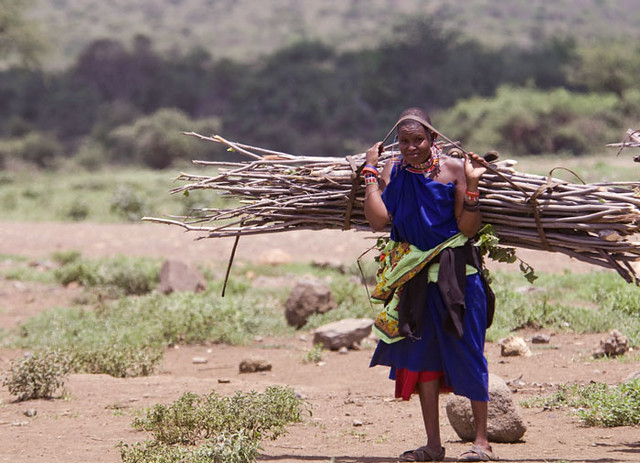 |
| Women burn more calories fetching firewood than they can afford to consume |

Furthermore, the Lentille community get a large proportion of their social and economic development off the back of their conservation efforts (see John’s weekly blog on this). Using up wood, a finite resource, in this way will eventually lead to deforestation, exacerbating poverty. In Kenya, over 100 million trees annually are used by rural families for energy consumption, whether burnt immediately or sold as charcoal (which by-laws, though in place, have not prevented as people need this small income.) This generates a massive amount of CO2, which goes directly against our conservation aims. Destroying trees further decimates the environment by allowing erosion (see photo), stopping grasses growing and causing a chain effect leading to desertification. No grass for livestock and more drought, which kills up to 90% of the herd (the only income for many families)- further poverty. Now that the Lentille community have put aside some of their land for conservation, they need an alternative fuel source, to save their lungs and their livelihoods.
Enter Paradigm Stoves: a commitment by one of our amazing partners, the Paradigm Project, to change 25 million lives by 2020. Real social, environmental and economic progress. For further info on Carbon offsetting, as mentioned in this video clip, keep reading John's weekly environment and conservation entries on this blog.
The Community Health Workers, Conservation Rangers and staff of the Sanctuary at Ol Lentille (over 60% of whom are from the local Maasai and Samburu communities) have been issued with Paradigm stoves, gratis, with the idea that they will act as Paradigm Ambassadors in the community, showing people the many benefits of these cookstoves over traditional cooking methods. So far, as a result, over 50 such stoves have been sold at a vastly subsidised price to other community members. Each manyatta is home to a family of about 7 people, almost 100 stoves have been distributed: this is improving the health of 700 community members and using 80% less wood fuel.
One stove saves $280, 1300 hours, 33 trees and reduces smoke by 60%.
The next stage is to provide larger versions of these stoves to the 8 schools that we work with for cooking lunches and boarders’ meals.
 |
| The cook at Ngabolo school looks forward to being able to cook for 400 kids much more efficiently! |
The Paradigm stove model works by ensuring a good draft into the fire, controlled use of fuel, complete combustion of materials, and efficient use of the resulting heat. It reduces fuel consumption by 80% and toxic smoke by 60%. For an idea of the sorts of stoves we are using, this video from the Global Alliance for Clean Cookstoves (UN) is a nice introduction.
It is also designed in such a way as to protect children from the fire. One of my first encounters with Kimanjo clinic, 6 years ago, was when driving around the area, responding to a call on the radio to collect a child from a manyatta and take him to clinic. This was in the days before Stephen, and there was no nurse present at Kimanjo. We picked up this child, aged about 18 months, with his hand singed, scalded and burnt through the skin, who didn’t cry, stayed cuddled to his mother and looked totally stoical, and drove him 40mins to the next nearest clinic, where we had to drive into the village to find the nurse. The hand was treated, bandaged and the mum told to return next day (we managed to find her a lift). The nurse did not look hopeful, and to my (relatively untrained) eye it looked like the child wouldn’t get functionality back in any of his fingers. But babies have an amazing power to heal, and today he is a happy kid with 5 working fingers and scars to tell the tale.
In an upcoming blog post, Nurse Steven will discuss his work in the community with the aforementioned Community Health Workers, and explain how problems such as malnutrition and maternal health are addressed. For now he, and all of us at the OLT, hope that this project will reduce the number of respiratory problems the Kimanjo Clinic and Nabakisho Healthcare Programme team have to deal with.
 |
| Community health workers from our Nabakisho Healthcare Programme arrive at Kimanjo clinic by bike |
Subscribe to:
Posts (Atom)