Showing posts with label women. Show all posts

Sunday, June 5, 2011

Ol Lentille Conservancy part 5: the future is global

We now have a community with diversified livelihoods, less dependent on livestock, which are so vulnerable to the massive problem of climate change. The land is improving, lessening the impact of climate change, the potential for abundant grazing is around the corner; and there is the prospect of carbon income.

So how does the community perceive these changes? In the (in)famous words of Bill Clinton (no not those words ;)):


This community has so far sacrificed 20,000 acres of their land for conservation. They could have used the grazing, or they could have rented it out. They could have put 2000 cattle onto that land for 6 months of the year. And they could have had an income from it of $30,000 per year. Instead, total economic input from all sources generated by the Project has averaged $400,000 a year for the past 5 years.

In itself this is a community development challenge: a large and sudden increase in income and wealth is something most people do not deal with very well. Look at lottery winners- no different here! The temptation for a corrupt elite to pocket the dosh is huge. So here, much (though not all) of the income goes into infrastructure projects like new and improved schools, additional clinic nurses, a mobile clinic. Decisions on what projects to undertake are taken jointly by community members (teachers, elders, ranch officials, ranch members etc) and Regenesis directors and staff.

Nkiloriti Nursery School in 2006
Inside new classroom number 2 at Nkiloriti, 2010

Under the agreement with Regenesis the approximately $50,000 a year which is free cash, deposited into the ranch bank account, has to be used “transparently and equitably for the benefit of the entire community”, and is audited. AWF has supported the setting up of a village microfinance bank, and community leaders including women (traditionally marginalized in this society) are getting financial and business training and advice.

Women of Lentille community, with visiting teacher from UK
This blog was supposed to be about our conservation strategy. For those disappointed that there are not lots of wildlife stories, I apologise. But conservation is not about wildlife. It is about people. (Though we do still get extremely excited when we spot the endangered African Wild Dog hunting in front of the lodge, and happily watch elephants ‘playing’ at destroying things for hours)

African Wild Dog in Sinyai lagha, Ol Lentille Conservancy
The biggest question of all though, is can conservation pay? The answer is yes. However, if the world wants to conserve the wildlife and ways of life of East Africa, it is the world which will have to pay. Rural East Africans can successfully be in the business of selling to a world market so-called “ecosystem services”, but the international community and its Earth Summits and the plethora of well-meaning but for 50 years wholly ineffective NGOs will have to wake up.


The Tanzanian government (the same one that wants to drive a highway through the Serengeti National Park), wants to put a soda factory on Lake Natron. Soda is an essential commodity chemical crucial to the lives of all who live in the “Western” world, manufactured in ugly and habitat-destroying factories. Lake Natron is at the heart of a vital ecosystem, and one of the world’s most stunningly beautiful places. Conservationists want to stop the soda factory. It’s my view that in that case the world community must pay Tanzania for the income lost. Don’t make Africa pay for your lifestyle!

Tuesday, May 17, 2011

I See You Through the Smoky Air

Those who follow us on twitter will know that Nurse Steven’s biggest problem in the Lentille community is respiratory disease. It is closely followed by diarrhoeal problems, and he spends a lot of time on maternal and child health (especially nutrition), but the most common presentation at clinic or on his rounds out-and-about in the manyattas is a cough, bad chest, breathing problems.

So what are the causes? A Maasai manyatta, though developing from the very traditional low-ceilinged mud-and-sticks, to a higher roofed, sometimes tin-roofed hut with larger window or door spaces, has very little ventilation. Food is cooked on a traditional 3-stone hearth, and the fire will burn the majority of the day and night. The manyatta has no substantial dividing walls and so the whole family sleep in smoke-filled air every night. The WHO says being trapped in a manyatta with these fires is the equivalent of smoking 40 cigarettes a day. But if they didn’t burn, they wouldn’t eat. 1.6 million die each year globally of cook-smoke related disease, mostly women and children. More children under 5 die from this than from malaria or malnutrition.
A woman in her home cooking on her open fire
So what can be done about it?

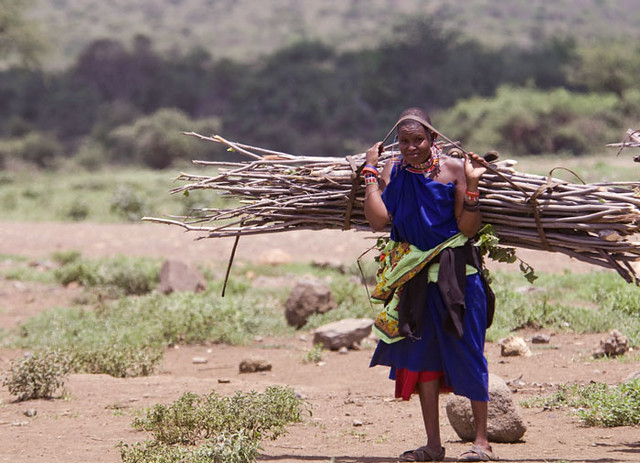
We need to reduce the amount of smoke and increase the efficiency of the fire. In order to do that, we must reduce the amount of fuel burned, or change the type of fuel. Living in a remote area, these families only have access to wood (or charcoal, often illegally made). Women spend around 4 hours each day collecting firewood and may have to walk several miles, burning calories they cannot afford to lose. This just to feed their families on fires that may be killing them.

Women burn more calories fetching firewood than they
can afford to consume

  
Furthermore, the Lentille community get a large proportion of their social and economic development off the back of their conservation efforts (see John’s weekly blog on this). Using up wood, a finite resource, in this way will eventually lead to deforestation, exacerbating poverty. In Kenya, over 100 million trees annually are used by rural families for energy consumption, whether burnt immediately or sold as charcoal (which by-laws, though in place, have not prevented as people need this small income.) This generates a massive amount of CO2, which goes directly against our conservation aims. Destroying trees further decimates the environment by allowing erosion (see photo), stopping grasses growing and causing a chain effect leading to desertification. No grass for livestock and more drought, which kills up to 90% of the herd (the only income for many families)- further poverty. Now that the Lentille community have put aside some of their land for conservation, they need an alternative fuel source, to save their lungs and their livelihoods.


Enter Paradigm Stoves: a commitment by one of our amazing partners, the Paradigm Project, to change 25 million lives by 2020. Real social, environmental and economic progress. For further info on Carbon offsetting, as mentioned in this video clip, keep reading John's weekly environment and conservation entries on this blog.


The Community Health Workers, Conservation Rangers and staff of the Sanctuary at Ol Lentille (over 60% of whom are from the local Maasai and Samburu communities) have been issued with Paradigm stoves, gratis, with the idea that they will act as Paradigm Ambassadors in the community, showing people the many benefits of these cookstoves over traditional cooking methods. So far, as a result, over 50 such stoves have been sold at a vastly subsidised price to other community members. Each manyatta is home to a family of about 7 people, almost 100 stoves have been distributed: this is improving the health of 700 community members and using 80% less wood fuel.

One stove saves $280, 1300 hours, 33 trees and reduces smoke by 60%.

The next stage is to provide larger versions of these stoves to the 8 schools that we work with for cooking lunches and boarders’ meals. 
The cook at Ngabolo school looks forward to being able
 to cook for 400 kids much more efficiently!
The Paradigm stove model works by ensuring a good draft into the fire, controlled use of fuel, complete combustion of materials, and efficient use of the resulting heat. It reduces fuel consumption by 80% and toxic smoke by 60%. For an idea of the sorts of stoves we are using, this video from the Global Alliance for Clean Cookstoves (UN) is a nice introduction.


It is also designed in such a way as to protect children from the fire. One of my first encounters with Kimanjo clinic, 6 years ago, was when driving around the area, responding to a call on the radio to collect a child from a manyatta and take him to clinic. This was in the days before Stephen, and there was no nurse present at Kimanjo. We picked up this child, aged about 18 months, with his hand singed, scalded and burnt through the skin, who didn’t cry, stayed cuddled to his mother and looked totally stoical, and drove him 40mins to the next nearest clinic, where we had to drive into the village to find the nurse. The hand was treated, bandaged and the mum told to return next day (we managed to find her a lift). The nurse did not look hopeful, and to my (relatively untrained) eye it looked like the child wouldn’t get functionality back in any of his fingers. But babies have an amazing power to heal, and today he is a happy kid with 5 working fingers and scars to tell the tale.

In an upcoming blog post, Nurse Steven will discuss his work in the community with the aforementioned Community Health Workers, and explain how problems such as malnutrition and maternal health are addressed. For now he, and all of us at the OLT, hope that this project will reduce the number of respiratory problems the Kimanjo Clinic and Nabakisho Healthcare Programme team have to deal with.

Community health workers from our Nabakisho Healthcare Programme
arrive at Kimanjo clinic by bike