Showing posts with label health. Show all posts

Friday, February 24, 2012

Batting AIDs out of Kenya with Cricket Without Boundaries....


Huge thanks  to "Cricket Without Boundaries” .. what a great job they are doing with their cricket coaching in Kenya.  In two days with us they will have taught cricket to over 500 kids in four schools.. in addition to training up a batch of over 20 very keen Maasai men and women. 


The energy and enthusiasm and great organisational skills  of their team has meant that the riotous fun of Pancake Day that started the week at Kimanjo Primary has just  continued to the week -end.
In addition to learning  a new sport the schools have been expertly, and highly imaginatively , taught about HIV/AIDS infection... the first time any educators have come with boxers and knickers for all teachers and older students  (boys and girls) .. boldly entitled  ‘Spread the Word Not the Infection.....‘   The girls were so amused there were tears of laughter. The ABC message was very clearly and creatively made. So how on earth does ‘C  is for Condom’ transfer to a cricket game? Ooh yes ... Condom = Protection =  protect your wicket- Inspired teaching!

Kids here are so quick to learn any new sport being fit, well coordinated and highly enthusiastic that it wouldn’t take long to get them playing a match. Cricket also allows the girls much more equality over the ubiquitous football that tends to dominate the school ‘field’ every break time. The trainee  coaches have enjoyed their sessions so much and the coaching has been so good that I am sure we will be able to get  some cricket clubs into operation this year.
                Both students and teachers are being motivated by the wonderful success of the local Maasai Cricket Warriors at Il Polei- due in no small part to Aliya Bauer their dedicated South African coach and coordinator. These ‘Warriors’ are currently having fun in Mombasa on cricket tour, as a prelude to  a tour to S Africa for The Last Man Stands  tournament. The Maasai Cricket Warriors’ also promote health messages against FGM and HIV and act as role models for their community: their own AIDS Awareness slogan is  "A BALL is my SPEAR and a BAT is my SHIELD in the FIGHT against A I D S"
                Sport is such a wonderful way to break down cultural divides and to act as a learning tool for other messages, and there are many great sporting initiatives throughout Africa. But without doubt Cricket Without Boundaries deserves to have all the recognition it can get, not just from dedicated cricketers, for the work they are doing in East and Southern Africa in schools and orphanages opening up a new sport, giving bat-loads of fun,  and an excellent  AIDS awareness message. Another  “Good news Africa” story then? We seem to have many of those this year.  After all- it is the energy and enthusiasm in the face of extreme adversity,  and the sense of community-that is the main reason for us choosing to be mzungus in Kenya ... and good sportsmen everywhere know a good deal about these qualities. 


                On tour with Cricket Without Boundaries is plenty of hard work in some fairly basic conditions... but this team  are at least able to enjoy a little bit of luxury and a chance to recharge their batteries at The Sanctuary at Ol lentille for a couple of nights.  Richly deserved!

Thursday, February 16, 2012

Neglected Tropical Diseases on Aljazeera


Following on from our blog on NTDs last week, this is the broadcast from the Al Jazeera news channel publicising and explaining the partnership between Pharmaceutical companies, governments and the public. What are your thoughts, readers? Positive or negative?

Wednesday, February 15, 2012

How to give sanitation sex appeal??


It’s hardly surprising that the building of pit latrines in the poorest countries is one of the least funded and most overlooked areas of health development. A vast amount more sex appeal will be found in other highly worthy public healthcare needs- malaria bed nights, for instance, undoubtedly save thousands of babies lives and are easy to distribute... in addition to lending themselves to great marketing opportunities to photo peaceful sleeping babies.  Yet 2.6 billion people  do not have access to a safe  latrine and this includes half of people in sub Saharan Africa. 

4,000 children die daily from preventable water related diseases- more than die from malaria, HIV and measles combined. Diarrhoea is the second biggest killer of children under 5.
Improved sanitation could prevent 1.5 million deaths from diarrhoeal diseases per year. The environmental rewards would also be enormous as currently 200 million tonnes of human waste go uncollected and untreated each year. It is estimated that every dollar spent on sanitation would save nine dollars in days lost from work plus the cost to the local health services. As much as  5% of African GDP is lost to illness and deaths caused by dirty water and lack of basic sanitation.
One of the Millenium development Goals is to halve the proportion of people without access to basic sanitation by 2015. Currently sub Saharan Africa will be at least fifty years late with this MDG unless the health agenda rapidly decided to focus money and effort here.
The added improvement to quality of life is probably larger than any other public health intervention. Whilst a good immunisation campaign will save millions of lives...it does nothing to improve the daily life of its recipients. Yet it doesn’t take much imagination to see that if you offer an adolescent girl an opportunity to use a safe,  private latrine  you have improved her life beyond measure. Certainly give girls access to education and books... but how many campaigns focus on giving her access to a childhood and adolescence where she can enjoy the basic human  right to personal privacy.
Of all the public health interventions we have undertaken this is the most universally popular one with the community.  Whilst it is very hard to evaluate whether families using pit latrines are accessing health care less, it is at least  easy to assess how much they are used : in every case the take up in use of the latrine amongst school age children and adults is virtually universal: if a latrine is there it is used by all but the youngest children and a few of the very old and infirm. In addition we have not yet come across a manyatta across the group ranches who have turned down the opportunity to have a latrine. 
But it is an expensive intervention. After we complete this year’s agreed building programme we will be working  with the micro finance project to see if they can help us with low interest development loans for pit latrines and looking to ways of cost sharing with families. But still it will remain expensive ..... and of course it is the poorest families who probably need the latrines most as their family numbers are generally higher and their health education is generally lowest. It is good to see some NGOs also focusing on latrines in Isiolo district- but here the problems remain the same; most NGOs will fund only basic materials, building and adding materials has to be added by families and consequently  they are out of the reach of the poorer families. In addition, not unnaturally it is the village ‘centres’ and schools which are generally targeted , where the need is highest, but again the poorest of the poor will miss out.

Saturday, November 26, 2011

Girl's Education.. Family Planning Choices.. and Fertility Rates...

On Tuesday,leaders from around the world meet in Senegal for the International Conference on Family Planning. As the population in Kenya has soared in the past 30 years by two and a half times, with an average growth of 3 percent per annum, this topic needs to be top of kenya’s development agenda.

The current Kenyan population level is 41 million, up from 21 million in 1989. There is no greater challenge to development, as over-population tends to nullify economic progress. With the advent of Free Primary Schooling in 2003, kenya did a great job of getting Bottoms On Seats. Access to education has improved enormously, but as population levels rise the GOK and donor governments have been unable to meet the required funding, particularly in the poorest rural areas where fertility rates remain highest. In schools we work with, if we removed our teaching support, class sizes would rise in some cases to 120 pupils to one teacher. Education for sure: but based on Quantity not Quality.

There is a clear correlation between levels of female education and female fertility rates. Education leads to delay of marriage, to increased knowledge about contraceptive choices, to greater economic choices for women, to increased autonomy in women’s decision making and to greater communication within marriage: all of these assisting in access to Family Planning and increased exercise of choice. As effective FP choices increase so greater education is required. With the advent of three year Implants, choices increase in both number and complexity.

It is inevitably the economic cost of education, versus its perceived benefits that will be the prime determinants of parents sending kids to school in the poorer rural areas. When the drought of 2009 in the Ol Lentille Community killed over three quarters of domestic livestock, not only did the schools see a large increase in enrollment of younger children, but also many Morans, who would formally have been out herding, entered primary school for the first time.

Seven or more years in school cuts fertility rates in half; but it is years in Secondary Education which has the greatest reduction in fertility rate for girls and the greatest delay in marriage. Educating mothers decreases child mortality and leads to healthier infants.Access to Family Planning is a basic Human Right which cannot be seen in isolation from those other basic Human Right- Female Education and the Right to Health Care.

Pictured are the Nabakisho Health Care nurses in action at a mobile clinic at Rumate where FP choices are discussed... levels of understanding of their full range of FP choices will remain hazy for many of these women who have no education.

Wednesday, May 18, 2011

This got me thinking...

This new data tool is my favourite toy of the day. It lets you display graphs of different development indicators and the relationships between them, based on the UN's Human Development Index model. This particular graph shows the relationship between adult literacy (Y) and life expectancy (X). The size of each bubble (which represent countries) indicates the GDP per capita and the colour shows the country's position on the Human Development Index, with red being the most 'developed' and blue the least.

You can see there is a strong correlation between X and Y- I've added the black line to demonstrate. So theoretically the better the adult literacy rate, the higher the life expectancy. Without going into cause and effect too deep (my brain is filled with ideas, but I fear I might bore you) and without listing the many variables, I'm going to say yes, education does contribute to better health, more opportunities, probably less conflict, and therefore higher life expectancy. It's clearly not the only factor, but that's all we're looking at here for now.

So why is Kenya an anomaly? For the level of adult literacy, it ought to have a much higher life expectancy. As it is, the literacy rate is 75%, but people are only living into their mid to late fifties (there are a lot of exceptions to this rule, notably the father of a good friend of ours, a Maasai elder in his nineties!).

If you look at the interactive version of this chart, you'll notice that pretty much all the outliers are African countries. Taking into account GDP (not a good indicator of social development as inequality is often a huge distorter) as well, South Africa and Equatorial Guinea have hugely low life expectancies for their economic development.

So what's the problem? An inadequate healthcare system...corruption, poor quality medicines, lack of funding, lack of good medical staff, lack of government focus? Too much disease that the health system cannot deal with- HIV/AIDS, malaria, TB? Too many people living in remote areas who cannot access the healthcare system and are therefore dying from preventable diseases- inequality and rural poverty? Road traffic deaths? Conflict? High child and maternal mortality due to nutritional problems (drought, famine, poverty, poor nutritional education), FGM, stigma of accessing peri-natal healthcare?

It's definitely something to think about...

Tuesday, May 17, 2011

I See You Through the Smoky Air

Those who follow us on twitter will know that Nurse Steven’s biggest problem in the Lentille community is respiratory disease. It is closely followed by diarrhoeal problems, and he spends a lot of time on maternal and child health (especially nutrition), but the most common presentation at clinic or on his rounds out-and-about in the manyattas is a cough, bad chest, breathing problems.

So what are the causes? A Maasai manyatta, though developing from the very traditional low-ceilinged mud-and-sticks, to a higher roofed, sometimes tin-roofed hut with larger window or door spaces, has very little ventilation. Food is cooked on a traditional 3-stone hearth, and the fire will burn the majority of the day and night. The manyatta has no substantial dividing walls and so the whole family sleep in smoke-filled air every night. The WHO says being trapped in a manyatta with these fires is the equivalent of smoking 40 cigarettes a day. But if they didn’t burn, they wouldn’t eat. 1.6 million die each year globally of cook-smoke related disease, mostly women and children. More children under 5 die from this than from malaria or malnutrition.
A woman in her home cooking on her open fire
So what can be done about it?

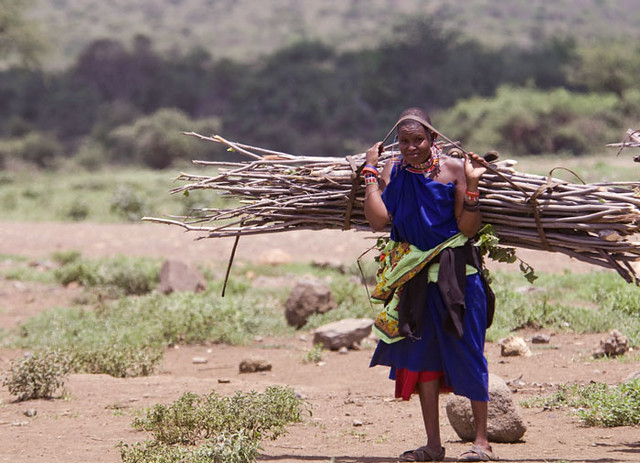
We need to reduce the amount of smoke and increase the efficiency of the fire. In order to do that, we must reduce the amount of fuel burned, or change the type of fuel. Living in a remote area, these families only have access to wood (or charcoal, often illegally made). Women spend around 4 hours each day collecting firewood and may have to walk several miles, burning calories they cannot afford to lose. This just to feed their families on fires that may be killing them.

Women burn more calories fetching firewood than they
can afford to consume

  
Furthermore, the Lentille community get a large proportion of their social and economic development off the back of their conservation efforts (see John’s weekly blog on this). Using up wood, a finite resource, in this way will eventually lead to deforestation, exacerbating poverty. In Kenya, over 100 million trees annually are used by rural families for energy consumption, whether burnt immediately or sold as charcoal (which by-laws, though in place, have not prevented as people need this small income.) This generates a massive amount of CO2, which goes directly against our conservation aims. Destroying trees further decimates the environment by allowing erosion (see photo), stopping grasses growing and causing a chain effect leading to desertification. No grass for livestock and more drought, which kills up to 90% of the herd (the only income for many families)- further poverty. Now that the Lentille community have put aside some of their land for conservation, they need an alternative fuel source, to save their lungs and their livelihoods.


Enter Paradigm Stoves: a commitment by one of our amazing partners, the Paradigm Project, to change 25 million lives by 2020. Real social, environmental and economic progress. For further info on Carbon offsetting, as mentioned in this video clip, keep reading John's weekly environment and conservation entries on this blog.


The Community Health Workers, Conservation Rangers and staff of the Sanctuary at Ol Lentille (over 60% of whom are from the local Maasai and Samburu communities) have been issued with Paradigm stoves, gratis, with the idea that they will act as Paradigm Ambassadors in the community, showing people the many benefits of these cookstoves over traditional cooking methods. So far, as a result, over 50 such stoves have been sold at a vastly subsidised price to other community members. Each manyatta is home to a family of about 7 people, almost 100 stoves have been distributed: this is improving the health of 700 community members and using 80% less wood fuel.

One stove saves $280, 1300 hours, 33 trees and reduces smoke by 60%.

The next stage is to provide larger versions of these stoves to the 8 schools that we work with for cooking lunches and boarders’ meals. 
The cook at Ngabolo school looks forward to being able
 to cook for 400 kids much more efficiently!
The Paradigm stove model works by ensuring a good draft into the fire, controlled use of fuel, complete combustion of materials, and efficient use of the resulting heat. It reduces fuel consumption by 80% and toxic smoke by 60%. For an idea of the sorts of stoves we are using, this video from the Global Alliance for Clean Cookstoves (UN) is a nice introduction.


It is also designed in such a way as to protect children from the fire. One of my first encounters with Kimanjo clinic, 6 years ago, was when driving around the area, responding to a call on the radio to collect a child from a manyatta and take him to clinic. This was in the days before Stephen, and there was no nurse present at Kimanjo. We picked up this child, aged about 18 months, with his hand singed, scalded and burnt through the skin, who didn’t cry, stayed cuddled to his mother and looked totally stoical, and drove him 40mins to the next nearest clinic, where we had to drive into the village to find the nurse. The hand was treated, bandaged and the mum told to return next day (we managed to find her a lift). The nurse did not look hopeful, and to my (relatively untrained) eye it looked like the child wouldn’t get functionality back in any of his fingers. But babies have an amazing power to heal, and today he is a happy kid with 5 working fingers and scars to tell the tale.

In an upcoming blog post, Nurse Steven will discuss his work in the community with the aforementioned Community Health Workers, and explain how problems such as malnutrition and maternal health are addressed. For now he, and all of us at the OLT, hope that this project will reduce the number of respiratory problems the Kimanjo Clinic and Nabakisho Healthcare Programme team have to deal with.

Community health workers from our Nabakisho Healthcare Programme
arrive at Kimanjo clinic by bike

Saturday, May 7, 2011

Techno-Maasai - the role of ICTs and mobile tech in development

The rate at which information and communication technologies have swept across East Africa has been phenomenal. Just watch this little clip to get an idea of the globalisation in action.


My most hilarious realisation of technicalisation (!) was when I was cycling through a neighbouring group ranch, en route to a picnic by the river, and a young man, dressed in full Samburu beads and shukas (blankets) stepped out into the road and produced his cameraphone to take a quick snap of these crazy wazungu cycling miles through choice just to have their lunch.

Anecdotes aside, mobile phones are simple, cheap, lifechanging devices, and big networks like Safaricom (Vodafone), are cashing in on developing clever new technologies targeting everything from poor rural areas and slums to rich city traders, surfing the wave of globalisation, money markets and broadband internet.

Phrases like 'mobile banking', mHealth and 'online learning' have only become prevalent relatively recently, but the development world and rural communities have got stuck in. There is obviously no mainline phone, internet or electricity provision to rural areas like Lentille, so mobiles, particularly now with the added option of solar chargers, are a real asset. The change this technology can provide to education, health, political participation, economic development and, obviously, communication is phenomenal.
The flexibility and varied applications of ICTs for development fit easily into the idea that poverty is multidimensional and not just a 'lack of money'. ICTs are invaluable for knowledge-sharing and information dissemination, essential for empowerment and therefore social and economic development. Some NGOs have used info-tech to disseminate campaign, advocacy and political information to mobile and remote communities via SMS empowering them with knowledge and encouraging participation in politics, justice systems and policy. This was popularised for the Kenyan constitutional referendum in 2010.

The sceptics’ view that “IT is totally irrelevant for the poor who are generally illiterate; IT is too expensive for them to reach out to; the poor don’t need fancy IT, they need food” is not only patronising, but wrong. People in poor and remote communities do 'fancy' mobile phones and it helps them access food, by empowering/educating communities and simply by improving communication:

David, a 60-something Maasai elder, is unemployed and living in a manyatta near Kimanjo village. His two children, Joseph and Mary (yes, really) work in Nanyuki town. If David did not have a mobile phone (a basic Safaricom model which he bought for 1000/= (£8) in Nanyuki after getting some casual work on an Ol Lentille Trust building project), he would be hungry and isolated. But now, he can call Joseph and ask him to send food, phone credit or money, get him to check market prices in Nanyuki so that when he visits the fortnightly Kimanjo market, he knows the fair price to pay, and, of course, he is able to keep in constant contact with his grown-up children.


The ideal approach is to use ICTs to ‘enable, strengthen or replace existing information systems and networks’ and focus on the actual needs of communities and how technologies can help, rather than just technology-driven projects. ICTs can be integrated into existing health, education, economic and political systems to improve them in ways the people want.

The current focus is on mobile communications technology and internet, having potential for rural development in sectors including education (e.g. creating e-literacy in schools or for distance learning), healthcare (e.g. rural practitioner to urban specialist communication), agriculture (particularly access to market information) and other business development (including entrepreneurial ventures based around the use of ICTs, such as mobile telephone kiosks). I'm not saying technology is a solution to poverty, but it should help poverty eradication to get there quicker.

The growing mobile banking sector is having a massive impact on rural development. mPesa (Safaricom's mobile bank) is simply amazing. Whereas our friend David would once have had to ask Joseph to entrust a few hundred shillings to a matatu (bus) driver between Nanyuki and Kimanjo, and be there at a specific time to pick it up, Joseph can now mPesa the money to his father, and David can pick it up, with a secure code from his mobile phone, from the mPesa outlet in Kimanjo village. People who do not have relatives in Nanyuki are saving the 300/= (2 days' work) return fare to the bank in Nanyuki, and with the ability to create free 'bank accounts' on their SIM cards, others are avoiding the costly process of setting up and maintaining an account with Barclays, Equity or somesuch. The concept of ‘banking the unbanked’ allows the poor majority access to markets, savings and improved financial security, integrating them into the national economy.

There is not much in Kimanjo aside from the school and clinic- a few bar/tea shops (though I discovered one now has a pool table!), the ubiquitous 'chapati-joint', a lot of stray dogs, a church or 2, a fortnightly market...but the mPesa outlet always has a queue (and sometimes runs out of cash- here the matatu driver still plays his role). You can pay bills, school fees, everything...it is revolutionary.

In the arid, remote Lentille area, John (Ol Lentille Trust Trustee and Sanctuary at Ol Lentille Director) spent yesterday training Kimanjo nurses Stephen and Joyce and Makesen, one of the community health workers, on the patient record software on their brand new laptop. Digitalisation of the clinic systems is a huge step forward, meaning Stephen will no longer have to rely solely on scraps of paper, unreliable supplies of MoH stationery and patients bringing their record books to consults. It will also help him monitor and evaluate the impact of healthcare in the area. It is a simple system, which takes a few hours to learn, and the portable laptop will be able to travel to mobile clinic days in remote parts of the area. They can also now connect to the internet, thanks to their Safaricom dongle, to send data to the MoH, do research, and communicate with health professionals worldwide.

The community health workers have also been issued with mobile phones. The Trust's Nabakisho Healthcare Programme issued the 25 CHWs with cameraphones (which now only cost about $30) to document their work in the community, which covers home based care and HIV awareness, hygiene and sanitation, nutrition FGM and family planning as well as more general health monitoring and advocating for increased use of the health facility, about which there is a stigma. They take photos of achievements in the community (e.g. latrines built,'leaky tins' used), problems and concerns they need to discuss with Stephen. The phones also have a video facility. Not only has it been a major advance for healthcare, but has also provided a further incentive for the CHWs as they can all use these phones for personal use as well.

An amazing school in the UK, Leamore Primary in Walsall and its highly IT-literate deputy head donated 5 laptops to Kimanjo Primary School. We tasked our GAP student and intern with teaching the teachers to teach IT (not such an easy task when they had to start by showing the teachers where the mouse was) and the headteacher Mr. Monto is now developing ideas to integrate IT into the curriculum, share the computers with neighbouring Kimanjo Secondary and get an after school computer club going. Unfortunately, due to lack of mobile signal, the school does not yet have internet access, but, since the government put solar power into all classrooms last year, the computers can be used throughout the school (just as well since their 6th computer is my old one which has 0 battery life!). Learning basic IT skills such as word processing is going to prove invaluable in giving these kids the best education possible to integrate them into the ever-more-globalised world we live in.
Kimanjo Primary teachers and laptops from Leamore


The school was also given video cameras, which they have used to make short films of Maasai daily life to send to partner schools in the UK- penpals for the 21st century. Amazing, considering a few years ago there was not only no electricity, but no means of communication outside Kimanjo without going for a long walk or paying hundreds of shillings for a matatu ride. Now, they are communicating with everyone from Ireland to Isiolo, learning, integrating and developing their own communities.

Phones, computers, cameras. Education, integration, knowledge, healthcare and empowerment. simple, amazing!

Tuesday, May 3, 2011

Education For All - a route to a future

In 2007, Kibaki's government promised free Secondary Education, following on from the universal free primary education policy rolled out in 2002. It has yet to be successfully implemented. The aim to provide children from poor backgrounds with fair access to education has been hindered by a lack of both government funding and government will. Without deviating from the topic into Kenya's issues surrounding corruption and tribalism, it is safe to say that a remote Maasai community, such as that around Ol Lentille, was never likely to be high on the list of priorities.


Consequently, many children from rural areas such as this have been unable to access secondary education. Primary education is often a struggle- there are no fees, but families are still required to supply uniforms, some books, there is often no food at school and in times of impending drought, pastoral families may move to better areas, or the father may be away with cattle, forcing children to stay home to look after the small livestock. Furthermore, with no electricity, water and firewood to collect, and parents who often did not have formal education, doing homework becomes impossible, meaning children from rural areas often struggle in school.

In the Lentille area, we have recently constructed a classroom, kitchen, latrines and store as the beginning of Kimanjo Mixed Day Secondary School. There is a fantastic teacher, Mr. Silanke (completing his B.Ed simultaneously), and a teaching assistant. The government are sending a headteacher (government partnership being at the heart of all our programmes to reduce aid-dependency). We are currently raising funds for a teacher/admin block and Class Two to allow the current crop of 25 Form 1 pupils to continue their education in 2012 and another form to be admitted. The next nearest schools are at Oldonyiro and Dol Dol, both of which are a public-transport ride or long walk away (several hours) and so children from Lentille area would have to board. This expense, on top of fees (which are high at the unsubsidised Dol Dol) is simply impossible for many families. At Kimanjo, costs are low, contributing only for lunch and the askari (security guard). This amounts to approx £25 per term and no child will be turned away for lack of fees.
In a letter to the primary donor, Mary, a Form 1 pupil wrote:

"Thank you for this golden chance, I could not have got education otherwise and would sit at home or become married. I now dream of becoming a secretary or a teacher when I finish and am a proud girl with my secondary education"


Jeremiah went one further with his ambitions- this is the sort of hope that this opportunity inspires in these youngsters:

“When I heard that the school was going to be built my heart melted with joy like butter exposed to direct heat. I want to be a politician and I promise that I will not be corrupt. All drug traffickers and corrupt politicians will rot in jail. I will fight hunger and poverty and kick HIV, malaria and cancer out of Kenya. I will work extra hard to make all of this come true”
So, why secondary education? Corruption and nepotism mean that the kenyan government are coming up short in several areas, so what made us focus on this for 2011? It is an extension of our support for Primary Education and Quality of Teaching and Learning, where we support 7 government primary schools with extra teachers, teacher training, resources etc., and we believe secondary education is crucial for the social, economic and political development that community members are striving for. Importantly, the decision to open a secondary school was taken by community members, including Kijabe Group Ranch chairman and Primary school head Mr. Monto, in partnership with the Ol Lentille Trust, and a lot of awareness raising and support gathering was done in 2010. It is a real community initiative, and here is why...

The Millenium Development Goals are an overview of the most important aspects of global community development. They specify Universal Primary Education (UPE) as a target for 2015 (Goal 2), but do not mention secondary education. However, it has been shown that secondary education feeds into many of the other MDGs.

Goal 1: Eradicate Extreme Poverty and Hunger: Secondary education gives kids more opportunities in life including better chances at employment/higher income, better knowledge of how to access services and justice systems, and confidence/ability to interact in community and political systems, thereby increasing their potential to advocate for more services/food/development in their area.


Goal 3: Promote Gender Equality and Empower Women: education fosters confidence, knowledge and therefore empowerment. The more girls that can access secondary education, the more equal society will become. In order to improve access to education for girls, costs must be driven down so families can afford not to have to choose between children. Educating boys further in subjects such as social science also allows them to have an informed opinion on gender equality, and education often means access to more developed communities/cosmopolitan towns and cities where gender equality may be higher on the agenda than in rural areas. Educated women are far more likely to send their daughters to school. It is amazing to see the impact education has on Maasai girls' ability to participate in society as much as the men do.


Goal 4: Reduce Child Mortality Rates: This has been empirically proven by UN statistics- a mother with secondary education has 50% less chance of her child dying before the age of 5 than a mother with no education. Education also improves family and child nutrition, reducing incidence of malnutrition or disease and strengthening immunity. Secondary educated women are far more likely to immunise their children and seek medical care when necessary. Healthcare provision often has a huge stigma in traditional communities. The photo shows our healthworkers carrying out nutrition assessments in the community.


Goal 5: Improve Maternal Health: Again very well shown by UN stats. In the Ol Lentille community, Female Genital Mutilation was at a rate of 95% up until 18 months ago, despite being illegal. Now, girls with a good primary education and the prospect of secondary are choosing to say 'no' to FGM and pick an alternative ceremony instead. They see an alternative to early marriage, conforming to dangerous tradition and having many expensive children, as they believe further education can provide a better life for themselves and their children. It is estimated that each year of secondary schooling reduces fertility rate by 10-20%. The average primary school leaver in the Lentille community will have 4 children, for a woman with secondary education this falls to two. Secondary educated women are more likely to use appropriate contraceptives and seek pre and post-natal care. "It is estimated that an additional year of schooling for 1,000 women helps prevent two maternal deaths." (World Bank, 2009)


Goal 6: Combat HIV, Malaria and Other Diseases: As previously stated, education improves chances of appropriate access to health services. HIV, TB, malaria and hygiene are also key parts of the science curriculum in both primary and secondary school in Kenya, so the more kids are taught, the more likely they are to be able to prevent themselves from contracting diseases. Educated kids are more likely to access contraception, and are more likely to understand the economic and social impacts on communities and countries of pandemics such as HIV. Educated girls are less vulnerable, more able to say 'no' to sex and 'yes' to contraception, reducing HIV spread through extra-marital relations etc.


Goal 7: Ensure Environmental Sustainability: secondary education provides kids with the chance to integrate into a wider community, through ICT (including in Kimanjo secondary), teachers from cities with global knowledge and a well developed curriculum. This means they are exposed to global debates on things such as climate change. Children in Kimanjo Secondary are particularly exposed to this, since their school would not exist without the amazing conservation efforts of their community (conservation supports tourism which attracted the major donor to the school and provides the surrounding group ranches with a consistent income from bednights, conservation fees and rent from the investor/managers). There are wildlife/conservation clubs and the Solomon and David, KPSGAs (Kenya Safari Guides) impart their knowledge on environmental issues. The school is solar powered and rainwater collection is a primary concern. The children are sensitised to these issues and the importance of sustainable development, in the hope that they will advocate for 'green' ideas throughout their futures.


So, you see, Secondary Education is of utmost importance, particularly to the girls of Lentille and the girls and boys who would not otherwise be able to afford to continue schooling. These sorts of local community schools are key to providing education to as many of the poorest kids as possible, as the central government is financially unable and politically unwilling to become more involved in these communities.


If you'd like to support the cause, go to www.justgiving.com/teamlentille3p or for more information, download the '3 peaks info pack' from http://www.ol-lentilletrust.org/ which is packed with info about the programme, the charity and how you can get involved.


I'll leave you with a quote from Josephat, one of the Kimanjo students:
“When I finish my education I would like to be President of my country, so that I will be able to build more educational buildings for the poorest children like me, so that everyone will be able to learn just like me. Thank you Charlie and I hope that when you read this work of my brain you will be as happy as Sandyboy [I think he means the Sand Man]”