Showing posts with label environment. Show all posts
Showing posts with label environment. Show all posts
Thursday, November 17, 2011
Poaching, rhino horn, education ..... and China links
Everyone enormously pleased to have John back in Kenya following his trip to China. China is not only an enormously important market for tourism in Africa, but it is also a cornerstone in the education fight to combat poaching of rhino horn and elephant ivory. As powdered rhino horn now equals the price of cocaine, surpassing that of gold, the market has become so lucrative that 2011 has seen a major increase in animals lost to poaching, destined for markets primarily in Vietnam and China. In an effort to raise Chinese awareness on this challenge Laikipia Wildlife Forum has hosted many senior Chinese entrepreneurs and government officials this year to show them the important rhino conservation work being done in Laikipia in conservancies such as Ol Pejeta and Ol Jogi. In the last month three elephants have been poached in areas relatively close to the Ol Lentille conservancy. John welcomed the chance to talk to many prominent Chinese business people, and we look forward next year to being able to show some of them these animals in their natural habitat. It is great to see this growing understanding that we must all be working together to extend these educative links: if the rhino is to survive much longer the power of the camera lens and the healthy safari experience has to be harnessed.... above that of the bullet and the supposed 'curative' effect of powdered horn.


Sunday, June 5, 2011
Ol Lentille Conservancy part 5: the future is global
We now have a community with diversified livelihoods, less dependent on livestock, which are so vulnerable to the massive problem of climate change. The land is improving, lessening the impact of climate change, the potential for abundant grazing is around the corner; and there is the prospect of carbon income.
So how does the community perceive these changes? In the (in)famous words of Bill Clinton (no not those words ;)):

This community has so far sacrificed 20,000 acres of their land for conservation. They could have used the grazing, or they could have rented it out. They could have put 2000 cattle onto that land for 6 months of the year. And they could have had an income from it of $30,000 per year. Instead, total economic input from all sources generated by the Project has averaged $400,000 a year for the past 5 years.
In itself this is a community development challenge: a large and sudden increase in income and wealth is something most people do not deal with very well. Look at lottery winners- no different here! The temptation for a corrupt elite to pocket the dosh is huge. So here, much (though not all) of the income goes into infrastructure projects like new and improved schools, additional clinic nurses, a mobile clinic. Decisions on what projects to undertake are taken jointly by community members (teachers, elders, ranch officials, ranch members etc) and Regenesis directors and staff.
 |
| Nkiloriti Nursery School in 2006 |
 |
| Inside new classroom number 2 at Nkiloriti, 2010 |
Under the agreement with Regenesis the approximately $50,000 a year which is free cash, deposited into the ranch bank account, has to be used “transparently and equitably for the benefit of the entire community”, and is audited. AWF has supported the setting up of a village microfinance bank, and community leaders including women (traditionally marginalized in this society) are getting financial and business training and advice.
 |
| Women of Lentille community, with visiting teacher from UK |
This blog was supposed to be about our conservation strategy. For those disappointed that there are not lots of wildlife stories, I apologise. But conservation is not about wildlife. It is about people. (Though we do still get extremely excited when we spot the endangered African Wild Dog hunting in front of the lodge, and happily watch elephants ‘playing’ at destroying things for hours)
 |
| African Wild Dog in Sinyai lagha, Ol Lentille Conservancy |
The biggest question of all though, is can conservation pay? The answer is yes. However, if the world wants to conserve the wildlife and ways of life of East Africa , it is the world which will have to pay. Rural East Africans can successfully be in the business of selling to a world market so-called “ecosystem services”, but the international community and its Earth Summits and the plethora of well-meaning but for 50 years wholly ineffective NGOs will have to wake up.

The Tanzanian government (the same one that wants to drive a highway through the Serengeti National Park ), wants to put a soda factory on Lake Natron Lake Natron Tanzania
Friday, May 20, 2011
Ol Lentille Conservancy part 3: Conservation for development
Seeing the very visible and dramatic changes in the health of this land, and also the tourism and community development benefits (such as education and healthcare programmes) the area was receiving, neighbouring communities asked to participate in the conservation programme. So the Ol Lentille Conservancy is now 20,000 acres belonging to 4 communities. This year we are set to go to close to 30,000 acres as a fifth community comes on board.

Now we know we can save degraded land and bring it back into good health, we have started scientific monitoring of plants and soil quality. We work with Kenyan environmental consultants Wajibu MS to do this. We have trained local monitoring staff and had Speedbird satellite imagery done to enable this. The International Livestock Research Institute whose global headquarters is in Nairobi
 |
| Ngabolo School children on a day out in the Ol Lentille Conservancy |
The 'carbon credits' phenomenon has been accused of a. not working to combat climate change and b. encouraging exploitation of developing countries. This may well be true at some levels. Of course the trading has to be done right, like all development programmes- the 'how' matters. Wangari Maathai, Nobel Peace Laureate, has endorsed the involvement of tree-farming in her Green Belt Movement in the Carbon market, knowing that if done right, carbon trading has true potential. Conservation here is about people, and finding a way to allow communities to sustain their way of life by improving their environment. Carbon trading can do that for this community. It provides an incentive to conserve land, bringing wildlife back into the area and retaining an ancient ecosystem. Income from carbon could provide potentially massive social development through funding education and healthcare programmes.
 |
| Elephant in Ol Lentille Conservancy, Jan 2011. There are now almost too many elephants in the area; there were none 6 years ago. |
It is little appreciated that the quantity of soil organic carbon (SOC) on Planet Earth far exceeds the carbon “sequestered” in the attention-grabbing rainforests. Now don’t get me wrong – the rainforests must certainly be saved. But with the exception of ILRI, little scientific attention is being paid to SOC, and no scientific methodologies for determining it and monitoring it have been so far approved for carbon-trading purposes. With the inadequacy of Earth Summits, especially the Copenhagen
The Ol Lentille Conservancy beneficiary communities could, we conservatively estimate, have an income of many hundreds of thousands of dollars over a 15 year period from 2015 by trading their carbon rights. This would be a major addition to their portfolio of income generating activities.
 |
| Tourism- one of the Lentille community's major income-generating activities |
You may have concluded that we can improve SOC levels just by resting land. You would be right in the short term. However, in the long term land can be over-rested. If grasses are insufficiently grazed they eventually become rank and moribund, and cease to replenish the soil organic matter and nutrients especially in a semi-arid climate like ours.
Of course, wildlife is the first to benefit in the Conservancy from improved grass and plant cover. However, when you have as much grass as we have you need a large number of big bulk grazers like zebra and buffalo, and it is only this year that zebra have returned to this area after long absence. And the three buffalo who visited us last August have long since disappeared. On a sidenote, we are very excited that our new zebra population consists of both the common Burchell’s zebra, and also the highly endangered Grevy’s zebra (less than 1500 left on earth).
 |
| The endangered Grevy's zebra- the Laikipia-Samburu ecosystem is their last major stronghold |
So what to do? We are planning to put cattle back in the Conservancy! Read on next week to find out why and how we have gone full-circle.
 |
| Allowing cattle into the conservancy would benefit both conservation and the cattle for whom there is not much food elsewhere: a double benefit for the community members |
Tuesday, May 17, 2011
I See You Through the Smoky Air
Those who follow us on twitter will know that Nurse Steven’s biggest problem in the Lentille community is respiratory disease. It is closely followed by diarrhoeal problems, and he spends a lot of time on maternal and child health (especially nutrition), but the most common presentation at clinic or on his rounds out-and-about in the manyattas is a cough, bad chest, breathing problems.
So what are the causes? A Maasai manyatta, though developing from the very traditional low-ceilinged mud-and-sticks, to a higher roofed, sometimes tin-roofed hut with larger window or door spaces, has very little ventilation. Food is cooked on a traditional 3-stone hearth, and the fire will burn the majority of the day and night. The manyatta has no substantial dividing walls and so the whole family sleep in smoke-filled air every night. The WHO says being trapped in a manyatta with these fires is the equivalent of smoking 40 cigarettes a day. But if they didn’t burn, they wouldn’t eat. 1.6 million die each year globally of cook-smoke related disease, mostly women and children. More children under 5 die from this than from malaria or malnutrition.
 |
| A woman in her home cooking on her open fire |
So what can be done about it?
We need to reduce the amount of smoke and increase the efficiency of the fire. In order to do that, we must reduce the amount of fuel burned, or change the type of fuel. Living in a remote area, these families only have access to wood (or charcoal, often illegally made). Women spend around 4 hours each day collecting firewood and may have to walk several miles, burning calories they cannot afford to lose. This just to feed their families on fires that may be killing them.
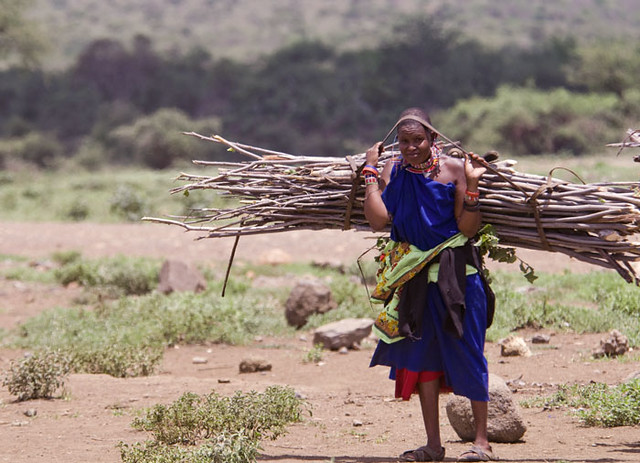 |
| Women burn more calories fetching firewood than they can afford to consume |

Furthermore, the Lentille community get a large proportion of their social and economic development off the back of their conservation efforts (see John’s weekly blog on this). Using up wood, a finite resource, in this way will eventually lead to deforestation, exacerbating poverty. In Kenya, over 100 million trees annually are used by rural families for energy consumption, whether burnt immediately or sold as charcoal (which by-laws, though in place, have not prevented as people need this small income.) This generates a massive amount of CO2, which goes directly against our conservation aims. Destroying trees further decimates the environment by allowing erosion (see photo), stopping grasses growing and causing a chain effect leading to desertification. No grass for livestock and more drought, which kills up to 90% of the herd (the only income for many families)- further poverty. Now that the Lentille community have put aside some of their land for conservation, they need an alternative fuel source, to save their lungs and their livelihoods.
Enter Paradigm Stoves: a commitment by one of our amazing partners, the Paradigm Project, to change 25 million lives by 2020. Real social, environmental and economic progress. For further info on Carbon offsetting, as mentioned in this video clip, keep reading John's weekly environment and conservation entries on this blog.
The Community Health Workers, Conservation Rangers and staff of the Sanctuary at Ol Lentille (over 60% of whom are from the local Maasai and Samburu communities) have been issued with Paradigm stoves, gratis, with the idea that they will act as Paradigm Ambassadors in the community, showing people the many benefits of these cookstoves over traditional cooking methods. So far, as a result, over 50 such stoves have been sold at a vastly subsidised price to other community members. Each manyatta is home to a family of about 7 people, almost 100 stoves have been distributed: this is improving the health of 700 community members and using 80% less wood fuel.
One stove saves $280, 1300 hours, 33 trees and reduces smoke by 60%.
The next stage is to provide larger versions of these stoves to the 8 schools that we work with for cooking lunches and boarders’ meals.
 |
| The cook at Ngabolo school looks forward to being able to cook for 400 kids much more efficiently! |
The Paradigm stove model works by ensuring a good draft into the fire, controlled use of fuel, complete combustion of materials, and efficient use of the resulting heat. It reduces fuel consumption by 80% and toxic smoke by 60%. For an idea of the sorts of stoves we are using, this video from the Global Alliance for Clean Cookstoves (UN) is a nice introduction.
It is also designed in such a way as to protect children from the fire. One of my first encounters with Kimanjo clinic, 6 years ago, was when driving around the area, responding to a call on the radio to collect a child from a manyatta and take him to clinic. This was in the days before Stephen, and there was no nurse present at Kimanjo. We picked up this child, aged about 18 months, with his hand singed, scalded and burnt through the skin, who didn’t cry, stayed cuddled to his mother and looked totally stoical, and drove him 40mins to the next nearest clinic, where we had to drive into the village to find the nurse. The hand was treated, bandaged and the mum told to return next day (we managed to find her a lift). The nurse did not look hopeful, and to my (relatively untrained) eye it looked like the child wouldn’t get functionality back in any of his fingers. But babies have an amazing power to heal, and today he is a happy kid with 5 working fingers and scars to tell the tale.
In an upcoming blog post, Nurse Steven will discuss his work in the community with the aforementioned Community Health Workers, and explain how problems such as malnutrition and maternal health are addressed. For now he, and all of us at the OLT, hope that this project will reduce the number of respiratory problems the Kimanjo Clinic and Nabakisho Healthcare Programme team have to deal with.
 |
| Community health workers from our Nabakisho Healthcare Programme arrive at Kimanjo clinic by bike |
Monday, May 16, 2011
Ol Lentille Conservancy Part 2: Creating Conservation
Part 2 of John's conservation story...


Under the agreement between Regenesis Ltd and the landowners (Kijabe and Nkiloriti Group Ranches), fees became payable immediately, even in the absence of a lodge or any guests. So the “economic engine” of the project started up early- the community gained financially just from Regenesis being there, and more so when the lodge was complete and guests began to arrive.
All the while, since 2000, the community had successfully excluded its own livestock from the conservation area and had eliminated poaching. Unfortunately neighbouring communities’ cattle were not so respectful, and the community had not enough resources and organisation to exclude them from the area. When John and Gill arrived in late 2005, it was obvious that the land was still being grazed on- ‘bomas’ were visible, you often saw Samburu herdsmen in the conservancy with their cattle and youngsters with sheep and goats. They knew they were not meant to be there and would run if you tried to talk to them, but always crept back in to the conservancy.
 |
| Cattle were a frequent sight in the conservancy in 2005-6 and still try to return if drought gets bad |
With the help of the world-famous Lewa Conservancy, John and his Head Ranger, Sergeant Samal Kimorgo (more commonly known as ‘Kilo 1’, his radio call-sign), turned the volunteers into an organized, trained, disciplined, well-equipped, uniformed, and paid security force. Pretty soon all livestock were being properly excluded from what had now become the Ol Lentille Conservancy.
 |
| Ol Lentille Conservancy Ranger at an Outpost. Teams of Rangers rotate on Outpost duty in various remote parts of the conservancy |
You may be asking why it was necessary to drive livestock out of the area. After all, cattle are the prized possessions of the tribesmen. Well, it’s fairly simple. The land had to rest. It was almost exhausted. There was no grass-cover with resulting loss of top-soil and huge erosion gullies. The soil had become capped with a hardened crust so any rainfall just ran off it. Because the land was permanently hot, rainfall was less likely. Invasive plant species, unpalatable to either livestock or wildlife, which thrive in poor soils had started to take over.
 |
| Opuntia, an invasive species which thrives in degraded soil |
Today, after 5 years of dedicated hard work, and even with 2 extreme drought years in that period (yes inter-drought frequency is decreasing – climate change is upon us here- it is also becoming more unpredictable, not like the El Niño/El Niña’s of old), the Ol Lentille Conservancy has abundant grass cover and the invasive species are dying out as soil quality improves, indigenous plant species thrive and smother, wildlife grazes and fertilizes the soil, and rainfall increases. Remarkably, since the water table has risen, a spring, long dead, has come back to life, and is a major magnet for wildlife.
 |
| Elephants in Ol Lentille Conservancy, 2010 |
Next week, we get into the science of conservation, showing how the Lentille conservation strategies can be extended and used to bring even more benefit to the communities here.
 |
| Greater Kudu in Ol Lentille Conservancy, 2009 |
Wednesday, May 11, 2011
Tourism and Development: a happy marriage?
"Ethical tourism” seems to be an “in” buzz-phrase right now. At least if the Guardian podcast of April 28th is anything to go by, but what does it mean? Like that other piece of jargon, “ecotourism”, any meaning it might have had has become obscured, layer upon layer, by those with questionable ethics and “green” credentials badging themselves this way without deserving or scrutiny. Greenwashing is an industry. Has ethicowashing become one too? How can we distinguish true ethical tourism from mere claims? What is at the heart of the idea?
Out of the podcast I picked up a few hints about what ethical tourism is supposed to be:
- Tourism should not be done in such a way as to weaken the local culture.
- Tourism should be well regulated by governments.
- Tourism is vital to the diversification of the income generating activities of poor communities.
- Tourism operators should pay fair wages and provide good conditions of employment.
- The tourism value chain should strive to ensure a “fair” proportion of the chain value is delivered to the host community.
- Local ownership of tourism assets works best.
- Tourism operators should not deprive their host communities of their full share of local resources e.g. water.
Now I’m going to embarrass myself. You see, we run a thing called the Ol Lentille Project. For sure we don’t always get it right, but we try our darnedest to be green and ethical, and I’d like to tell you how. Blowing your own trumpet can be very ugly, and (for a Brit at least) is always embarrassing.
The Ol Lentille Project is a 3-legged stool in poverty-stricken Maasai and Samburu communities in Laikipia, Kenya on the semi-arid edge of the fabled Northern Frontier District deserts. The legs are economic development, conservation, and community development. Get one of these wrong, and your stool falls over. At the risk of mixing my metaphors, the stool is also a (potentially) virtuous circle, each leg depending on and supporting the others.
In our case most of the economic development comes from tourism (a ‘lodge’ – 4 private fully-staffed houses – called The Sanctuary at Ol Lentille. Without good conservation of habitat and wildlife in the 20,000 acre Ol Lentille Conservancy, there would be no tourists, and without good community development benefits, the community would not support conservation. Or maybe they would not support tourism either – like the community of Nazareth, Colombia, who have banned tourists for damaging their culture. Trying to get all 3 legs of the stool strong and the same length is an interesting challenge. But how dull would life be without problems to solve?
 |
| Tourists take in the conserved land at the Sanctuary at Ol Lentille |
To return to the hints I picked up from the podcast:
Tourism should not weaken the local culture. Here, pastoralism is the way of life. It is the culture. In its heyday, East African pastoralists were freely ranging herdsmen, following the rains and the grass with their livestock over vast distances: an adaptive existence. The top business schools now teach adaptive management, the Maasai got there first. Our world might move fast, but in developing countries, pastoralists are dealing with seismic change: climate change. In one year pastoralists may lose 80% of their livestock (almost all of their assets and income) to starvation, and inter-drought time is decreasing. With no asset security through livestock, pastoralists are increasingly seeking other livelihoods strategies. Mostly, they want education for their children. Those children are not likely to want to follow the cattle like their fathers. Schools are not nomadic. Pastoralists want their children to live near the schools, so sendentarisation is now the norm. Settlements like Kimanjo grow, putting pressure on natural resources, especially water. Health facilities, markets and shops follow. The result: degradation of habitat for both livestock and wildlife. Result: no wildlife for tourists, and less likelihood of a traditional and well-preserved culture being available for the rest of us to learn from.
 |
| Traditional Maasai culture |
What can we do about it; and what are we doing at the Ol Lentille Project?
We are building schools, striving for these schools to deliver high quality education, supplementing scarce government teachers with additional ones, providing training and resources. All our school builds include capacity for rainwater catchment and storage; and all the schools we support have conservation in the curriculum.
 |
| Nursery children at an Ol Lentille Trust- supported school |
We are introducing a strategy (a philosophy?) for conservation grazing, to improve and maintain a habitat fit for wildlife and livestock. And we have helped the community to set up a “living museum of Maasai life”: an opportunity for tourists to learn (and provide some income to the community), for people to continue in the pride of their traditions, and for the young to re-connect with their roots. Against the forces of economic and social change, a burgeoning population, and climate change, these are drops in the ocean, but we feel we are making a big difference in a small place.
Tourism should be well regulated by government. Kenya is the third most corrupt country in Africa (equal to Zimbabwe- would you put people's livelihoods in the hands of that government?). The chances of good regulation, undistorted by the purposes of the kleptocracy, are remote. Kenya works, and is largely a stable democracy, because of its bright, well-educated and energetic people. It works because it has a vigorous free press. And it works because of very high levels of freedom to do the right thing. The price of that is, of course, a very high level of freedom to do the wrong thing. We welcome international scrutiny and audit of what we do. We strive for it to be the right thing – always with the community not for the community. John Githongo's 'Ni Sisi' work emphasises that the way to get Kenya's corruption levels down is to start at the grassroots. Educating, developing and lifting a community out of poverty will allow them to participate more in political circles, 'empowering' them with the knowledge, ability and confidence to hold their government to account at all levels.
 |
| Read Michaela Wrong’s book ‘It’s Our Turn To Eat’, the story of Githongo (pictured)’s fight against corruption in Kenya if you want to learn more. |

Tourism is vital to the diversification of the income generating activities of poor communities. We agree. However, tourism is a fickle business, riding the waves of fashion, the state of the global economy, and fears of real or imagined insecurity. Sure, encourage community based tourism to thrive, but let it not dominate the local economic landscape – or the landscape, come to that. The Ol Lentille Project strives to provide sufficient community development to allow people to diversify in other ways, beoming less reliant on livestock which is dangerous in these environmentally unpredictable times. Bioenterprise, microfinance programmes, further education and employment in schools provide further opportunities.
 |
| A University graduate from Lentille community, pursuing alternative livelihood strategy and reducing dependence on risky ones |
Interesting to notice that in the context of ethical tourism, the moral compass does not always point true north. Almost a million tourists a year come to Kenya, as already noted the 3rd most corrupt country in Africa. Some 300,000 even visit Myanmar each year, human rights abuse as a way of life notwithstanding. However, if Kenya lost its tourism revenue, the percentage of revenue that is used for development would be slashed, harming people's livelihoods, perpetuating poverty and hindering people's ability to hold. It is an issue which puts moral compasses into a spin, and even Aung San Suu Kyi has asked tourists to return to Burma to support the country's social development and learn first hand of the political issues it faces. Discerning consumers need to be discerning tourists too. Do ask difficult questions. Do find out who REALLY benefits from your tourism dollar.
Tourism operators should pay fair wages and provide good conditions of employment. Absolutely. When we set up here we conducted the area’s first salary survey, and pitched our salaries and conditions 20% better than the top decile. This is way above the Kenya legal minimum (which has just been raised to $34 per month for unskilled workers). All our employees are on permanent contracts. We do not hire and fire at will. We did have to have layoff in the wake of the 2008 post-election violence in Kenya when no tourists came, but we have since compensated staff. We do have a business to run and cost management is important. It is not as important as delighting guests and generating revenue, but it is important, or we would not be able to keep the Project going. If the state of the nation’s roads was better, our transport and supply costs (40% of our total cost base) would fall and even more could go into salaries.
 |
| Staff from the Sanctuary at Ol Lentille relaxing at a community party |
The tourism value chain should strive to ensure a “fair” proportion of the chain value is delivered to the host community. Who is going to judge what is fair? In 2010 we paid fees to our host community of $38,000. The business did not turn a profit that year. Overseas travel agents and tour operators charged us 25% of our revenue to supply 70% of our guests. The truth is that without those tour operators we would not have a business - no business no donors. Income to the community from sources other than fees (including donations by our guests) in 2010 was some $350,000. The "value chain" in the tourism industry is not simple, and does not lend itself to simplistic nostrums.
Local ownership of tourism assets works best. We agree. We donated $1.6 million, the African Wildlife Foundation $100,000, and we got the European Union/Tourism Trust Fund of Kenya to put up a further $300,000 to build The Sanctuary at Ol Lentille – an immoveable asset. The community owns it. We manage it under long term contract. You may be thinking whoever did that must be out of their tree-maybe! I think it was Voltaire who coined the phrase “enlightened self-interest”. Too often, in East Africa at least, there is conflict between the landowner and the tourism investor. There is just no mutuality of interest. Ever wondered why so many “lodges” are tented camps? So they can be whisked away to another location in the case of unresolvable conflict. Since our community owns the main business asset their interest in its success is exactly identified with ours. Result: no (or very little) conflict.
Tourism operators should not deprive their host communities of their full share of local resources e.g. water. Once again, absolutely. 80% of water here is rainwater catchment. The other 20% comes from a distant borehole drilled and maintained at the expense of the business. Earlier this year all of our water sources dried up – ah climate change. Again. We did have to buy water from a neighbouring community who have a very productive government-funded borehole, but we offered them 30% more money for the water than they were charging their own community members. That cash provided much needed additional funds for secondary school bursaries – secondary schooling is not free in Kenya. Other local natural resources we use, we pay for: sand and stone for building; the average annual return to the community on grass is 650% per annum (see that explained in John's Conservancy blog series).
And what of “ecotourism”? This, surely, goes hand in hand with ethical tourism, since exploiting a community's natural resources exploits both them and their environment. As I’ve already noted, only 20% of our water comes from an aquifer. All our hot water and electricity is provided by solar. All our rooves catch rainwater. All our grey water is recycled. All our waste is recycled or composted. When we have completed the land rehabilitation work on the recently added 15,000 acres of the Conservancy and measured the success of that work scientifically we are confident that even if guests do not offset their airline carbon, our carbon footprint will be neutral. In 2012 we will begin a programme of supplier selection taking account of their “greenness” too.
 |
| Houses at the Sanctuary at Ol Lentille with rooves designed for water catchment |
When John was a young man, working at an asbestos mine in Swaziland, he was sent by the British head office of the company to make sure that none of the mine’s salary policies were racially discriminatory. They were. So he proposed the solution of converting African workers rations’ into additions to their salaries. The following month there was a long line of miners wanting salary advances! Their salary increase was all spent. But just a moment, this was not their fault – what had the company done to provide any training or advice about household budgeting for a much larger and now independent income? Nothing.
The price of rapid and large economic development at the community level is not much different it seems to me. It has to be accompanied by training and advisory services in ranch governance and financial management – what the international aid community calls capacity building I guess. We’re happy to say that AWF are now doing that, which will help to further ensure that tourism is a positive development experience here.
Monday, May 9, 2011
Ol Lentille Conservancy Part 1: The beginnings
Welcome to Part 1 of this 5-part series from Lentille director, John. John is passionate about all things conservation and development, but mainly about how conservation is done. This blog will tell the Lentille story and explain the strategy taken and how it benefits the community in a fair, successful, sustainable way.

In this weekly blog series I’m going to tell the story of how 20,000 acres of semi-arid land in the north of Laikipia, a district of Kenya, was brought back from the brink of destruction by a desperate, but conservation-minded community of Maasai and Samburu people.
In the appalling drought year of 2000, 80% of Maasai and Samburu tribesmen’s livestock had died. These already poor communities were on the edge of starvation. Livestock dependency had caused this (remoteness, tradition and lack of access to services meant other livelihoods were not considered), as well as ruthless over-grazing. How would it be possible to survive and make money out of their land if livestock was going to be such a risky investment?

The community decided to put some of its land into conservation for wildlife, in the hope that they might get some tourism income out of it. The African Wildlife Foundation - AWF supported their efforts and gave conservation advice. In fact the community of Kijabe Group Ranch set aside for conservation, and stopped all grazing on, a whole one third of their land: 5000 acres. 15 men of the community volunteered, for no reward, to protect it from livestock incursion and poachers.
In 2003, the construction of a tourism property was started, but the project failed, and building was halted.
 |
| View of the Ol Lentille Conservancy, 2006 |
In 2005 Regenesis Limited, a Kenyan company owned by British social investors John & Gill Elias made a 25 year agreement with the community to manage conservation and tourism on their behalf. Regenesis had been set up specifically to invest in, donate to, and manage community-based conservation tourism. Crucially, Regenesis passed ownership of the $2 million lodge it constructed during 2006 to the community. Stories of exploitation and dispossession of communities by investors abound in East Africa . This was not to be one of them- the community would be the owners and the beneficiaries.
 |
| The 'Library' at the Sanctuary at Ol Lentille |
Find out next week how the community made a success of their conservancy, and the benefits it has brought.
Subscribe to:
Posts (Atom)